
Updating your news feed...
NEWS EXPRESS is Nigeria’s leading online newspaper. Published by Africa’s international award-winning journalist, Mr. Isaac Umunna, NEWS EXPRESS is Nigeria’s first truly professional online daily newspaper. It is published from Lagos, Nigeria’s economic and media hub, and has a provision for occasional special print editions. Thanks to our vast network of sources and dedicated team of professional journalists and contributors spread across Nigeria and overseas, NEWS EXPRESS has become synonymous with newsbreaks and exclusive stories from around the world.





.webp)


.webp)
.webp)
.webp)

.webp)







Despite the sunny weather in Lagos in recent days, many residents are yet to recover from the shock of the devastating downpour witnessed a few weeks ago, which wreaked havoc on homes and businesses across the city.
Apart from exposing the city’s perennial struggle with flooding, blocked drainage channels and poor waste management, the deluge also disrupted commercial and transportation activities.
For instance, despite several visits and assurances by officials of the Lagos State Government to address the situation, residents have become apprehensive whenever the sky becomes cloudy.
“Every downpour now brings fears of our properties being damaged, our livelihoods being disrupted, prolonged traffic congestion and avoidable health risks,” a resident of Lagos Island said.
Recounting his experience, Mr Alao Taofeek, a resident of the Patey area on Lagos Island, described the recent rainfall as devastating, particularly for traders in Ofin, Balogun, Idumota and Ereko markets.
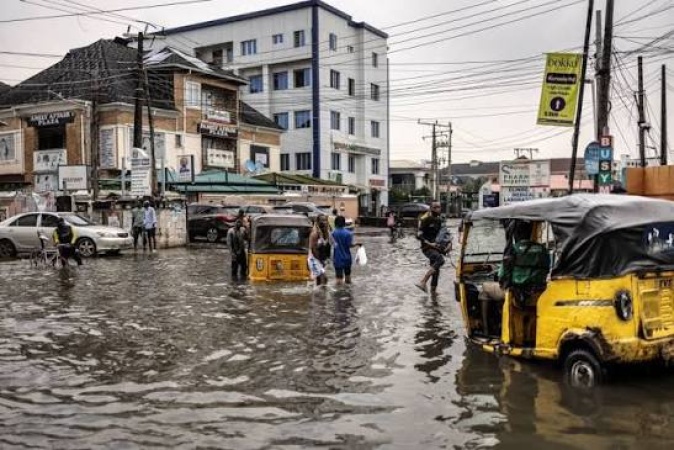
“They couldn’t trade because it was a total shutdown. It was more than rainfall; it was like a river overflowing. Students were almost swept away, while cars, tricycles and buses were submerged. School buses used by the two local councils to convey pupils were also damaged by the flood,” he said.
According to him, the flood reflected the growing challenges of rapid urbanisation, poor waste management and inadequate drainage infrastructure in Africa’s largest city.
Alao argued that the Ilubirin development altered the natural water channel that once served the area.
“Where the Ilubirin Estate now stands used to be a river. After it was sand-filled for construction, the water lost its natural outlet and now flows back into surrounding communities whenever there is heavy rainfall,” he said.
He also blamed indiscriminate waste disposal and poor access for waste collection vehicles on Lagos Island’s narrow streets.
“LAWMA trucks cannot access many inner streets because they are too narrow. Residents are left with few options, and some dump refuse by the roadside. Those who previously disposed of waste at Tinubu Square can no longer do so, while cart pushers have also been stopped from operating. All these contribute to blocked drains and flooding.
“This persistent flooding serves as yet another reminder that until the structural and environmental factors driving the crisis are addressed, the state will continue to experience not only flooding but also economic losses, environmental hazards and hardship for communities across Lagos,” he added.
Taofeek blamed the persistent flooding mainly on blocked drainage channels and the sand-filling of the Ilubirin area.
Also, at Iyana-Ejigbo in the Egbe-Idimu Local Council Development Area, commercial activities came to an abrupt halt during the period as floodwaters inundated the main market, forcing traders to abandon their stalls in a desperate bid to save their goods.
For many traders, the experience has become an unfortunate annual ritual. However, the immediate concern is survival. Every heavy rainfall now brings fears of damaged property, disrupted livelihoods, prolonged traffic congestion and avoidable health risks.
One of them, Mrs Ajoke Sekinat, said repeated appeals to the authorities had yielded little result. “Whenever it rains, there is no peace of mind for traders. The drainage channels are blocked, and we understand that the market was built on a natural waterway. That is why we experience severe flooding after every heavy rainfall,” she said.
She also blamed indiscriminate waste disposal, saying canals in the area are clogged with plastic waste, discarded tyres and other debris that prevent the free flow of stormwater.
A similar situation played out in Idi-Oro, Mushin, where floodwaters washed heaps of uncollected refuse onto major roads, worsening environmental and traffic conditions.
According to her, residents always watched helplessly as stagnant water mixed with refuse, creating an unhealthy environment and making movement difficult.
the popular plantain market, trader Mrs Fausat Kayode described the flooding as both an environmental and public health concern.
Visitation by government
However, the full complement of the state’s officials that visited the flood-affected areas in Eti-Osa Local Government recently was, without doubt, seen by many as reflecting the magnitude of the impact of the recent heavy rainfall on communities across the city and demonstrating the level of attention the environmental disaster was receiving from the government.
Interestingly, it provided an opportunity for the team, led by Governor Babajide Sanwo-Olu, his deputy, Dr. Obafemi Hamzat; the Commissioner for the Environment and Water Resources, Mr. Tokunbo Wahab; the Commissioner for Information and Strategy, Mr. Gbenga Omotoso; and others, to assure the affected communities, whose infrastructure had been devastated by the recent flood, of the government’s determination to address the situation and prevent a recurrence.
Not a few believe that more of such visits and reassurances have become imperative to calm frayed nerves and restore the people’s dwindling confidence in the state government’s ability to tackle the perennial problem. But the state government says it remains determined. It noted that with sustained investment in drainage infrastructure and flood mitigation projects, flooding would eventually become a thing of the past.
The Commissioner for the Environment and Water Resources, Mr. Tokunbo Wahab, while speaking during an extensive inspection of critical drainage infrastructure and flood control projects across Lagos, said the challenge was not insurmountable.
He expressed regret over the persistent reports of flooding in the area despite the completion of major drainage infrastructure more than two years ago. According to him, the drainage system was designed to discharge floodwater by gravity into the lagoon, but the deliberate blockage of its outlet had severely undermined its effectiveness.
“We discovered that the outlet into the lagoon had been deliberately blocked. Without opening that channel, the water cannot leave the area. We have therefore directed that it be reopened immediately in the overriding public interest,” he said.
The commissioner warned that obstructing drainage channels would continue to expose residents to severe flooding despite the government’s huge investment in flood control infrastructure.
“You can imagine the level of flooding within the community, yet the government is often blamed for inadequate infrastructure. Taxpayers’ money is being used to construct and maintain these drainage channels, and residents should not worsen the situation by blocking them. We will continue to clear all obstructed drainage channels wherever they are found in the overriding public interest,” he added.
Saturday Tribune reports that from the Mainland to Lagos Island and many inner communities, floodwaters submerged major roads, markets and residential areas, disrupting commercial activities and leaving motorists and commuters trapped in hours-long traffic gridlock.
Across the state, the scenes were familiar. Traders scrambled to rescue their wares, commuters were stranded at bus stops, while tricycles, minibuses, private vehicles and commercial buses struggled through flooded roads. For residents, it was yet another period they would rather not relive.
A commercial bus driver in Ikotun, Mr. Kayode Olakanmi, lamented the impact of the flooding on transport operators, saying gridlock had left buses trapped for hours while passengers remained stranded at bus stops across the state.
“We spend hours in traffic, burning fuel while passengers are stranded at bus stops each time it rains. By the time we get out of the congestion, the rush hour is over and we struggle to meet our daily target. Most times, we cannot even remit the expected daily returns to the vehicle owner, let alone make enough for ourselves.
“The government needs to address this problem urgently. It is difficult to understand why the city is still overwhelmed by flooding each time it rains. Many roads are submerged, and we constantly take our vehicles to the mechanic because of flood-related damage. We lose productive hours on the road and spend our hard-earned income on repairs that could have been avoided,” he said.
But as residents wait for the state government to fulfil its promise of finding a lasting solution to flooding in the city, every change in the weather has become a nightmare, and the rain, generally regarded as therapeutic, continues to be a source of anxiety for many living in the State of Aquatic Splendour. (Saturday Tribune)





