Updating your news feed...
NEWS EXPRESS is Nigeria’s leading online newspaper. Published by Africa’s international award-winning journalist, Mr. Isaac Umunna, NEWS EXPRESS is Nigeria’s first truly professional online daily newspaper. It is published from Lagos, Nigeria’s economic and media hub, and has a provision for occasional special print editions. Thanks to our vast network of sources and dedicated team of professional journalists and contributors spread across Nigeria and overseas, NEWS EXPRESS has become synonymous with newsbreaks and exclusive stories from around the world.























Loading banners
Loading banners...

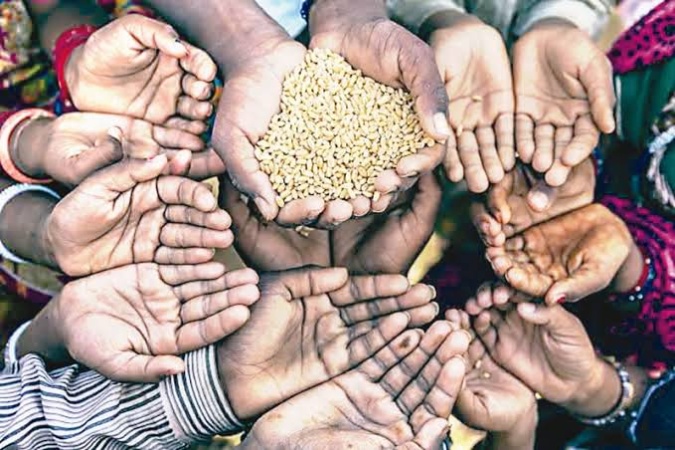
Africa has become the world’s hunger epicentre, having an estimated 309 million hungry people, with countries such as Nigeria facing an increasingly severe food and nutrition crisis.
The State of Food Security and Nutrition in the World 2026 (SOFI 2026) report, released on Tuesday by five United Nations agencies, reveals that the continent is now home to an estimated 309 million hungry people—the highest number of any region globally and exceeding Asia’s 292 million.
Although Africa recorded a slight improvement, with the share of its population experiencing hunger declining from 20.3 percent in 2024 to 20.0 percent in 2025, rapid population growth means the total number of hungry people continues to increase, underscoring the scale of the crisis.
Globally, an estimated 7.8 per cent of the world’s population experienced hunger in 2025, down from 8.1 per cent in 2024 and 8.6 per cent in 2022. Around 645 million people faced hunger last year—nearly 14 million fewer than in 2024 and 43 million fewer than in 2022.
For Nigeria, Africa’s most populous nation, the findings reinforce growing concerns over worsening food insecurity driven by persistent inflation, insecurity in food-producing communities, climate-related shocks and declining household purchasing power. Millions of Nigerians continue to struggle to afford nutritious meals as food prices remain elevated and agricultural production faces repeated disruptions.
The report paints an even starker picture when broader food insecurity is taken into account. While an estimated 25.8 per cent of the global population—about 2.1 billion people—experienced moderate or severe food insecurity in 2025, more than half of Africa’s population (56.6 per cent) struggled to access sufficient or nutritious food.
By comparison, the figure stood at 20.3 per cent in Asia, 22.9 per cent in Latin America and the Caribbean, and just 8.7 percent in North America and Europe.
Women and rural communities continue to bear the heaviest burden across the continent, including in Nigeria, where conflict, displacement and economic hardship have made access to adequate nutrition increasingly difficult.
Although Asia and Latin America have recorded steady improvements in recent years, Africa’s progress remains fragile and insufficient to put the continent on track to achieve Sustainable Development Goal 2—Zero Hunger—by 2030.
The report warns that recent geopolitical tensions in the Middle East, alongside climate shocks and shrinking humanitarian assistance, could reverse the modest gains recorded globally.
Depending on how long the conflict continues to fuel food inflation through higher energy and fertiliser prices, between 510 million and 520 million people could still be facing hunger by 2030. These projections do not account for additional disruptions, including severe weather events such as the El Niño episodes expected in 2026 and 2027, which could further worsen the outlook.
The report’s authors—the Food and Agriculture Organisation (FAO), International Fund for Agricultural Development (IFAD), UNICEF, World Food Programme (WFP), and World Health Organisation (WHO)—warn that conflict, climate change and declining development financing are undermining efforts to eliminate hunger.
The report also highlights the rising cost of eating healthily, noting that the global average minimum cost of a healthy diet increased to 4.28 purchasing power parity (PPP) dollars per person per day in 2025, up from 3.44 PPP dollars in 2021.
While the number of people unable to afford a healthy diet has fallen globally to 2.69 billion, Africa is moving in the opposite direction.
According to the report, an alarming 66.6 per cent of Africans could not afford a healthy diet in 2025—the highest proportion of any region and more than double the levels recorded in Asia and Latin America.
The report attributes as much as 75 per cent of the price consumers ultimately pay for food to inefficiencies across food value chains, including processing, transportation, storage and wholesale distribution. It argues that greater investment in infrastructure, irrigation, cold-chain systems, research and market reforms is critical to lowering food prices across the continent.
The UN agencies stressed that while recent progress demonstrates that hunger can be reduced, far more ambitious action is needed.
FAO Director-General Qu Dongyu said ending hunger and making healthy diets affordable would require stronger political commitment, sustained investment and policies that build more resilient agrifood systems.
Similarly, IFAD President Alvaro Lario called for increased investment in resilient food value chains, while UNICEF Executive Director Catherine Russell warned that millions of children continue to be failed by food systems that place nutritious food beyond their families’ reach.
WFP Acting Executive Director Carl Skau said conflict and climate shocks are driving vulnerable families deeper into hunger, while WHO Director-General Dr Tedros Adhanom Ghebreyesus stressed that healthy diets should never be treated as a luxury but as a fundamental requirement for good health.
Despite modest global improvements, the report concludes that Africa remains the epicentre of the world’s hunger crisis. For countries such as Nigeria, reversing the trend will require urgent action to tackle insecurity, boost agricultural productivity, strengthen food supply chains and make nutritious diets affordable for millions of vulnerable households. (Nigerian Tribune)