ADAD
ADAD
Updating your news feed...
NEWS EXPRESS is Nigeria’s leading online newspaper. Published by Africa’s international award-winning journalist, Mr. Isaac Umunna, NEWS EXPRESS is Nigeria’s first truly professional online daily newspaper. It is published from Lagos, Nigeria’s economic and media hub, and has a provision for occasional special print editions. Thanks to our vast network of sources and dedicated team of professional journalists and contributors spread across Nigeria and overseas, NEWS EXPRESS has become synonymous with newsbreaks and exclusive stories from around the world.









Loading banners
Loading banners...

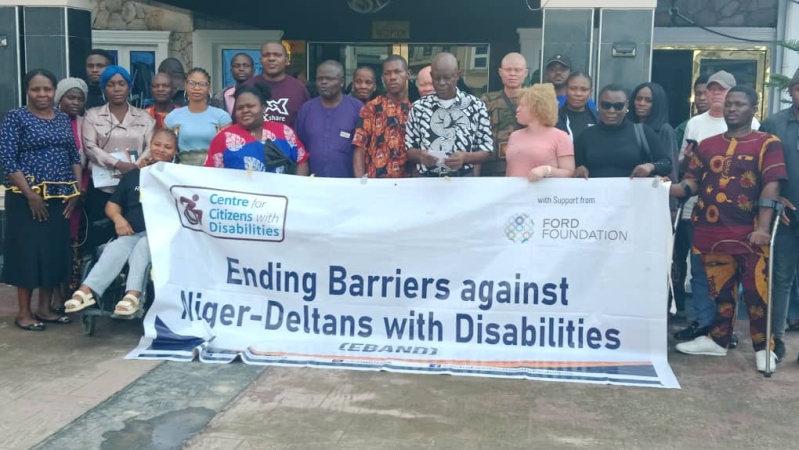
Some of the participants at the event
The Persons living With Disabilities (PWDs) from the oil-bearing communities in Delta have called on the relevant authorities to include them in the Petroleum Industry Act (PIA) 2021 benefits structures.
They made the call at a two-day advocacy workshop organised by the Centre for Citizens with Disabilities (CCD).
The programme was held between Thursday and Friday at Orhoro Community in Uvwie Local Government Area of the state.
The event, which was convened in support with the Ford Foundation, had its theme: “Ending Barriers against Niger-Deltans with Disabilities (EBAND)”.
Addressing the participants, Mr Godwin Unumeri, the Acting Director of CCD Said that the essence of the engagement was to among others, enlightened the people on the provisions of the PIA 2021 and how it affects them.
He said that the PIA was established in 2021 by the Federal Government to address the development shortfall in the Niger Delta, particularly the oil-producing communities.
He, however, noted that’the PIA excluded the PWDs from the benefits structures.
“The purpose of this programme is to ensure the PWDs are included in every benefits the PIA has put on the ground,” he said.
Unumeri said that several trainings were being organised for the men, women and youth in most of the host communities without the inclusion of the PWDs, a situation, he said required improved advocacy.
He said that advocacy of the PWDs should be targeted on inclusion in the PIA to enable them to partake in whatever was accruing from the Act to their communities.
He described the PWDs exclusion from the PIA as a systemic discrimination, and urged them to remain united and speak with one voice.
“In your various communities, you will notice that there are several trainings being organised for women, men and youth, but the PWDs are not carried along.
“At the end of this programme, you will know how to carry out advocacy in the proper ways and benefit from what the PIA is already delivering in the host communities,” he said.
Unumeri, while encouraging the participants to take advantage of the workshop, insisted that they should know the needs in their various clusters.
Speaking on the topic: “Inclusive HostCom Structures and Entry Points” Unumeri insisted that PWDs ought to be part of the decision-making process with regards to the PIA in the oil-bearing communities.
He, however, expressed displeasure that PWDs were excluded from the structures.
“Stakeholders which could the community leaders, oil companies or Board of Trustees should be bombarded with information about the PWDs and why they should be included in the decision-making,” he said.
Earlier, Mrs Florence Austin, the Manager, Finance and Administration of CCD said that the organisation was registered in 2002 with a mandate to promote equal opportunities, respect and dignity for PWDs across the country.
Mrs Austin added that the Non-governmental Organisation also carried out advocacy for PWDs as well as empowering them to know their rights.
“PWDs are vulnerable in the society. They are exposed to stimatization, discrimination, isolation, exclusion from decision-making among others.
“We ensure that the government make policy frameworks that protect and promote the rights of the PWDs,” she said.
Mrs Austin recalled that the Discrimination Against Persons with Disabilities (Prohibition) Act of 2018 was passed,
And wondered why the PIA 2021 could not absorb some of the contents in the disabilities act.
On her part, Florence Attah, Senior Programme Officer of the CCD, in her presentation, said that the PIA provided that oil companies should set up Host Community Development Trusts (HCDTs).
According to her, the Act also provided that oil companies should contribute three per cent of the operating expenses of their previous year to the Trust’s Fund
She also that the Act provided for the constitution of Host Community Board of Trustees (HCBoTs) as well as Host Community Advisory Committee (HCAC).
She expressed dissatisfaction that the PWDs were not factored into any of the three highlighted structures.
Attah said that the intervention tools needed in implementation of the PIA were: Host Community Needs Assessment, Community Development Plan and Community Budgets.
“The PIA made express provisions for consultation and consideration of the reasonable
Concerns of women, youth, and community leaders and excluded the PWDs,” she said.
Attah said that of major concerns to the CCD was how the PWDs could benefit from the PIA when the Host Communities discriminate, exclude and stimatized by reasons of disability.
She urged the PWDs to intensify advocacy on their exclusion from the PIA benefits structure.
Attah highlighted some of the purposes of advocacy to include: educating stakeholders about issues that need to be addressed as well as to change the attitude and misconception about the PWDs
She also said that advocacy could helped policy-makers to develop inclusive policies.
Attah urged the people to do thorough research on issues or problems before embarking on advocacy and also maintained consistency.
Attah reminded the participants to always expect potential backlash while planning for advocacy and also dressed properly to command respect and values.
“You are address the way you dressed,” she said.
Speaking with NAN at the end of the programme, Unumeri described the workshop as very successful.
“The testimonies that came out of the entire exercise, particularly acknowledgement by the participants that they have been doing advocacy but have not applied some of the strategies we taught them in this exercise is awesome.
“Many of them do not know that if you want to do advocacy, you need to have a comprehensive information, because it is about changing the perception of people and trying to influence them to buy into your agenda.
“In the case of the PWDs, the agenda is that they want to be included in the PIA benefits structure without prejudice, believing that they have qualified people who can also operate at very high standards like those that are included in the structure.
“Many of them have promised us that they will follow up for more information whenever they encounter challenges in any aspect of the advocacy technique we have impacted in them,” Unumeri said.
Responding on behalf of the participants, Mr Onyema Steven from the Albinism cluster, thanked the organisers for the impactful workshop.
“The programme has empowered us in the areas of inclusiveness and knowing our rights as approved by the PIA. The PWDs are supposed to be among the decision-making in any programmes that comes up in the PIA.
“The programme has also empowered us to know what we are supposed to know and to educate our members who are not privileged to be part of this programme to also understand their rights.
“In all, it has been a great programme and we really enjoyed it. God bless the CCD as we look forward to more of this kind of a gesture,” Steven said.
Highlight of the programme was the practical demonstration of how to engage the Community Head and HCBoT on the inclusion of the PWDs in the PIA benefits structure.
The participants were drawn from various PWDs clusters which included: the Physically challenged, Albinism, Blind, Deaf/Dumb, Spinal cord injury and Blind/Visual impairment.