ADAD
ADAD
Updating your news feed...
NEWS EXPRESS is Nigeria’s leading online newspaper. Published by Africa’s international award-winning journalist, Mr. Isaac Umunna, NEWS EXPRESS is Nigeria’s first truly professional online daily newspaper. It is published from Lagos, Nigeria’s economic and media hub, and has a provision for occasional special print editions. Thanks to our vast network of sources and dedicated team of professional journalists and contributors spread across Nigeria and overseas, NEWS EXPRESS has become synonymous with newsbreaks and exclusive stories from around the world.











Loading banners
Loading banners...

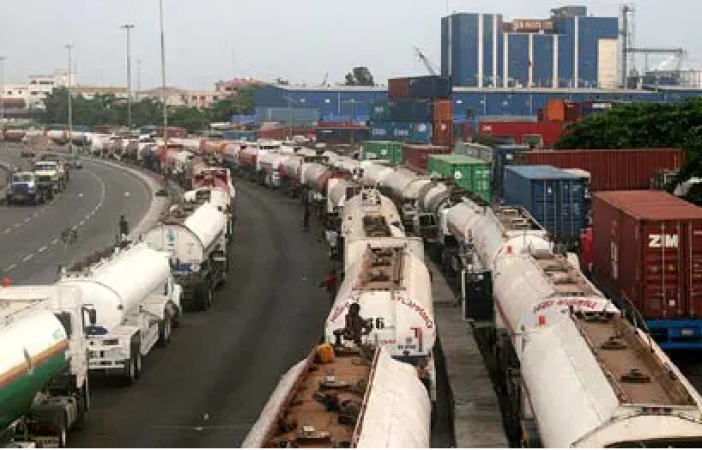
Tankers and trailers causing gridlock along the Oshodi-Apapa Expressway
Motorists and commuters were stranded for hours in traffic, yesterday, following a gridlock caused by an upsurge of tankers along the Oshodi-Apapa Expressway that obstructed vehicular movement and blocked access and other link roads.
After several months of respite, gridlock returned last week as tankers took over the Oshodi-Apapa Expressway from the Otto Wharf-Kirikiri axis, with traffic stretching as far as Mile 2 Bus Stop.
When contacted, LASTMA Director of Operations, Peter Gbejemede, blamed the resurgence of traffic on oil depots located around the Kirikiri axis, which failed to provide access for tankers into their premises, leading to a gridlock along the expressway.
According to Gbejemede, “Following public complaints, the General Manager immediately ordered the deployment of officers to the affected area to ensure the free flow of traffic.
“We have been appealing to the drivers to find alternative parking locations, as any vehicle found causing obstruction on the road by tomorrow (today) will be impounded and the owners made to face the consequences.
“We will not tolerate any form of indiscipline on the road. Let me make it very clear that we will impound vehicles found blocking access roads along the Mile 2-Kirikiri axis from Tuesday (today). Offenders will be charged accordingly.”
Stakeholders, however, blamed shipping companies and terminal inefficiencies for the growing congestion.
National President of the Council of Maritime Transport Unions and Associations, COMTUA, Yinka Aroyewun, blamed MSC and Maersk Line for worsening the gridlock, citing their failure to evacuate empty containers as a major cause of port congestion.
In an interview with Vanguard, Aroyewun explained that while cargo is being offloaded at the ports, empty containers are not being evacuated because shipping lines have not made their vessels available.
“The terminals are full because the shipping companies are not evacuating their empty containers. The bottleneck is causing trucks to queue along access roads, waiting to drop off empty containers. The congestion starts inside the terminals and spills back onto the roads,” he said.
Aroyewun added that Truck Transit Park Limited, TTP, continues to dispatch trucks without adequate coordination with terminal operators.
According to him, if the situation persists, the union may be forced to take action.
“If the problem continues over the next one or two days, we will instruct our members to drop the empty containers at designated locations and bill the shipping companies before they can recover them,” Aroyewun said.
He clarified that the issue is different from demurrage, which involves charges for cargo overstaying at the port.
“Our trucks are holding empty containers and cannot operate. This is different from demurrage, and we need a practical solution,” Aroyewun added.
On engagement with the Nigerian Ports Authority, NPA, he said the association has consistently reached out, but the authority either claims ignorance or gives the impression that the matter is under control.
“This has been going on for the last two weeks,” he noted.
On his part, the National President of the National Council of Managing Directors of Licensed Customs Agents, NCMDLCA, Lucky Amiwero, said persistent gridlock and high operational costs at Apapa Port are forcing importers to divert cargo to neighbouring countries such as Togo and Ghana.
Speaking to Vanguard, Amiwero said the port’s electronic call-up system has been compromised, while multiple agencies impose excessive charges, making it more expensive to clear goods in Nigeria than in neighbouring ports.
“Traders are now paying more to move goods through Apapa, so many are relocating their cargo to other ports where it is cheaper and more efficient.
“If urgent reforms are not implemented, congestion will worsen and more businesses will bypass Apapa entirely,” he warned.
When contacted, the General Manager, Corporate and Strategic Communications of Truck Transit Park Limited, TTP, Nancy Nnmadi, noted that the Mile 2-Apapa traffic has nothing to do with TTP.
She said: “From Ijora Long Bridge down to A.P. Filling Station, the road is free, while from A.P. Filling Station down to Eleganza Roundabout, we have flatbed trucks lined up on the first lane while the second lane is free.”
On the gridlock along the Mile 2-Apapa expressway, witnessed by Vanguard, which caused private car owners to abandon their vehicles and seek alternative transportation, Nnmadi said: “I just passed Mile 2. That has nothing to do with TTP. Also, it’s not a standstill situation. That’s where I drove past to work this morning and it was completely free. So it’s intermittent.”
Meanwhile, a port traffic management official, speaking on condition of anonymity, said the buildup of trucks on access roads was largely the result of slower-than-expected terminal operations, which has contributed to gridlock extending beyond the port environment.
“When the roads are full, you cannot keep releasing trucks,” the official said, noting that congestion affects not only port activities but also everyday movement for residents and businesses in surrounding areas.
According to the official, traffic coordination teams typically respond to such situations by notifying relevant agencies to temporarily slow or suspend the batching and release of trucks until congestion eases.
When contacted, the NPA spokesman, Ikechukwu Onyemechara, promised to call back after explaining the situation at Apapa and the Mile 2 corridor, but did not do so as of press time.
Also, the spokesman of the Nigerian Maritime Administration and Safety Agency, NIMASA, did not respond to calls from Vanguard correspondents.
The Head of Public Relations, Nigerian Shippers’ Council, NSC, Rebecca Adamu, also promised to call back but had yet to do so as of press time.
Meanwhile, the Lagos Sector Commander of the Federal Road Safety Corps, FRSC, Kehinde Hamzat, has warned that the agency would do everything within its capacity to prevent traffic gridlock within the Mile 2 axis.
According to the Sector Commander: “We will not tolerate a situation whereby truck drivers make life unbearable for other Nigerians, as they did a few years ago, which prompted the Federal Government to set up a presidential task force to tackle the problem.”
He noted that the Apapa-Oshodi Expressway is very important to Nigerians because it leads to the nation’s biggest port.
To this end, he said that the FRSC would deploy its heavy-duty towing trucks to remove trucks that fail to obey traffic rules and regulations within the area.
“I have taken time to engage our Apapa Unit Command, and I am also deploying my men from the state command to bring sanity to the area,” he said.
“We are also setting up a meeting with terminal port operators within Kirikiri Town and the Apapa Expressway axis to permanently prevent traffic gridlock.”
The Sector Commander also disclosed that the agency plans to liaise with armed-bearing sister agencies to tackle the problem.
The approach, he said, would solve the problem within a short time.
“If we do it over a period of time, it will send a signal to transporters that it is no longer business as usual,” he said.
Efforts to reach the Lagos State Commissioner for Transportation, Oluwaseun Osiyemi, yesterday, proved abortive, as he neither responded to calls pulled through his mobile phone nor replied text message sent to him. (Vanguard)