Updating your news feed...
NEWS EXPRESS is Nigeria’s leading online newspaper. Published by Africa’s international award-winning journalist, Mr. Isaac Umunna, NEWS EXPRESS is Nigeria’s first truly professional online daily newspaper. It is published from Lagos, Nigeria’s economic and media hub, and has a provision for occasional special print editions. Thanks to our vast network of sources and dedicated team of professional journalists and contributors spread across Nigeria and overseas, NEWS EXPRESS has become synonymous with newsbreaks and exclusive stories from around the world.



















Loading banners
Loading banners...

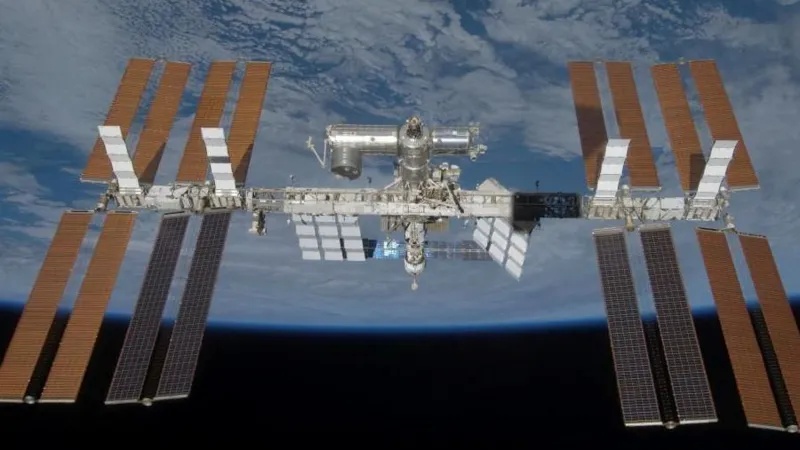
The ISS
Astronauts have been told to return to the International Space Station (ISS) after sheltering in their spacecraft while repair works were carried out on new air leaks in the Russian segment of the station.
The five crew members had been told to assume an "elevated safety posture" as two Russian cosmonauts attempted repairs on the Zvezda service module's transfer tunnel.
Nasa said the segment had suffered from cracks and leaks "for some time" - our science correspondent Pallab Ghosh reports this is not the first time the station has had to deal with such a problem.
Russia's Interfax news outlet reported Roscosmos as saying two leaks were identified and one has already been fixed.
It added that the crew and the ISS onboard systems were also not in danger, according to reporting by Russia's Tass news agency.
Nasa spokeswoman Bethany Stevens said the structural repair works had been paused while measurements and data were being assessed, prompting the astronauts' being told to return to the station.
The problem is in the PrK - a small tunnel that connects a docking port to the Russian Zvezda service module. Microscopic structural cracks in its walls have been slowly releasing air into the vacuum of space.
The Russian Space Agency, Roscosmos, first reported the leak in September 2019. Over time it worsened, eventually doubling to around nearly one kilogram of air lost per day — prompting Nasa to classify it as the station's highest-level safety risk.
Earlier this year, engineers thought they had finally made progress. After multiple inspections and sealant applications, Nasa reported in January that pressure readings suggested a stable configuration had been reached - though there remained uncertainty about whether the leak had truly been sealed or whether air was simply escaping elsewhere.
Those doubts proved well founded. On 1 May, as Russian cosmonauts unloaded cargo from the Progress 95 supply spacecraft, sensors detected a fresh pressure drop. The leak had returned.
By Monday this week it had escalated once again to a kilogram of air per day, prompting Roscosmos to abandon its mend-and-make-do approach and go for a proper repair today.
The reason five crew members sheltered in the Dragon spacecraft is straightforward: the repair requires the cosmonauts to work inside the very section that is losing pressure.
If the cracks widen suddenly, the rate of air loss could accelerate faster than ground teams could compensate for. Having the rest of the crew suited up and inside a sealed, self-contained spacecraft means they can undock and be home within hours if the situation deteriorates.
The seven crew members currently aboard the International Space Station represent five countries and a remarkable range of backgrounds.
Jessica Meir, 48, commands the Crew-12 mission. Born in Caribou, Maine, to Israeli and Swedish immigrant parents, she holds a doctorate in marine biology and once studied how emperor penguins hold their breath in Antarctica. She made history in 2019 as part of the first all-female spacewalk. She is a mother and a private pilot, and is conversational in both Swedish and Russian.
Jack Hathaway, 44, is Crew-12's pilot and a US Navy Commander from South Windsor, Connecticut. He trained as a test pilot at the Empire Test Pilots' School in the UK before being selected by NASA in 2021.
Sophie Adenot, 43, is a French colonel, helicopter test pilot and the second French woman ever to reach space, inspired as a teenager by watching Claudie Haigneré launch to the Mir space station. She speaks four languages, is a certified yoga teacher and a trained skydiver.
Chris Williams, 42, is a Nasa physicist and former cancer researcher at Harvard Medical School and Brigham and Women's Hospital who pivoted from studying the early universe for his MIT doctorate to treating tumours before becoming an astronaut. He also volunteered as a firefighter and EMT.
Sergey Kud-Sverchkov, 42, the station commander, is a rocket engineer born in Baikonur — the very city from which so many space missions have launched. He graduated with honours from Moscow State Technical University and worked as an engineer at RSC Energia before being selected as a cosmonaut in 2010. He was awarded the Hero of the Russian Federation after his first ISS mission in 2020. He has also trained in underground cave systems in Sardinia and studied planetary geology in the Dolomites as part of ESA's astronaut preparation programmes.
Sergei Mikaev, 39, is on his first spaceflight. Born in Irkutsk in Siberia, he rose to Major and commander of a military aviation unit in Primorsky Territory — Russia's remote far east, bordering China — before being selected as a cosmonaut in 2018. He is married with two children.
Andrey Fedyaev, 45, is a Russian cosmonaut and former Air Force major from Serov in the Ural mountains, on his second spaceflight. When he flew on Crew-6 in 2023, he became only the second Russian cosmonaut ever to launch aboard an American commercial spacecraft. He is now on his second mission, again flying alongside Nasa colleagues aboard Dragon.
"Given this development, NASA has instructed the crew members inside the Dragon spacecraft to end the safe haven procedures and return to planned operations aboard the International Space Station.
"We look forward to working with Roscosmos on a collaborative approach to address the leaks."
If the air leak in the Zvezda service module continues to worsen, the ISS crew has a clear emergency exit plan — but it involves splitting up across two separate spacecraft.
Five of the seven crew members are currently sheltering inside the docked SpaceX Crew Dragon "Freedom" spacecraft as a precautionary measure.
Nasa has directed Crew-12 astronauts Jessica Meir, Jack Hathaway, Sophie Adenot and Andrey Fedyaev to take refuge there, along with Nasa astronaut Chris Williams.
They have been told to put on their spacesuits so they are ready to undock and return to Earth at short notice. The Dragon effectively functions as a lifeboat — attached to the station but ready to detach the moment the order is given.
The two Russian cosmonauts, station commander Sergey Kud-Sverchkov and flight engineer Sergei Mikaev, are in a different position entirely.
They remain in the Russian segment - closest to the leak - carrying out the repair work. Their escape route is the separately docked Soyuz MS-28 spacecraft.
However, in a full evacuation, the crew would not simply leave on whichever vehicle they are currently sheltering in.
Crew members are assigned to specific return vehicles before they ever launch.
That means Dragon would carry the four Crew-12 members - Meir, Hathaway, Adenot and Fedyaev - splashing down off the US coast, while Kud-Sverchkov, Mikaev and Williams, all of whom launched together aboard Soyuz MS-28 last November, would make a separate landing on the Kazakh steppe.
For now, Nasa is emphasising this is a precautionary measure, not a full evacuation order. The agency says it is monitoring the situation closely and working with Roscosmos on a more permanent fix. But with suits on and engines ready, the crew is prepared to leave at a moment's notice.
International Space Station
The International Space Station (ISS) has been orbiting the Earth for 25 years and is perhaps the most complex international engineering project ever built.
The space station is made up of Russian and US segments, and there are modules from the European and Japanese space agencies too.
About the length of an American football field, it travels at 17,000 to 17,500 mph and orbits the Earth roughly every 90 minutes.
As well as conducting experiments that have been sent up to the space station, the astronauts themselves are test subjects and undergo measurements before, during and after their space flights to help us better understand how humans can survive long duration missions - with most crews serving on board for around six months.
This is not the first time the station has had to deal with this problem — the cracks responsible have persisted on and off for around six years.
However, following the arrival of a Russian cargo ship last month, the Russian Space Agency Roscosmos noticed a fresh slow pressure drop in the tunnel, prompting the decision to move beyond patchwork fixes and attempt a more extensive repair operation today
Here's the full statement from Nasa spokeswoman Bethany Stevens, released a short while ago:
"The Zvezda service module transfer tunnel, known as PrK, has suffered from cracks and leaks for some time, and has been mitigated by Roscosmos as much as possible to date.
"The cracks have always been a concern that NASA watches very closely. NASA and Roscosmos have been working to determine the root cause of the cracks, and Roscosmos manages the issue through operational mitigation measures and periodic partial-repair efforts.
"Following new leaks, Roscosmos has elected to proceed with a more extensive repair operation on Friday, June 5.
"Out of an abundance of caution, NASA has directed all four of the agency's SpaceX Crew-12 members and NASA astronaut Chris Williams to assume an elevated safety posture in the Dragon spacecraft while the repair is underway.
"We continue to work with our Russian counterparts, along with the rest of the international community that supports the space station, to arrive at a more permanent resolution."
Astronauts aboard the International Space Station have been told to shelter on their spacecraft as repair work is carried out to fix new air leaks, Nasa says.
"Out of an abundance of caution, Nasa has directed all four of the agency's SpaceX Crew-12 members and Nasa astronaut Chris Williams to assume an elevated safety posture in the Dragon spacecraft while the repair is under way," the space agency says.
This is a breaking news story and we'll bring you more information as we have it. (BBC)