Updating your news feed...
NEWS EXPRESS is Nigeria’s leading online newspaper. Published by Africa’s international award-winning journalist, Mr. Isaac Umunna, NEWS EXPRESS is Nigeria’s first truly professional online daily newspaper. It is published from Lagos, Nigeria’s economic and media hub, and has a provision for occasional special print editions. Thanks to our vast network of sources and dedicated team of professional journalists and contributors spread across Nigeria and overseas, NEWS EXPRESS has become synonymous with newsbreaks and exclusive stories from around the world.




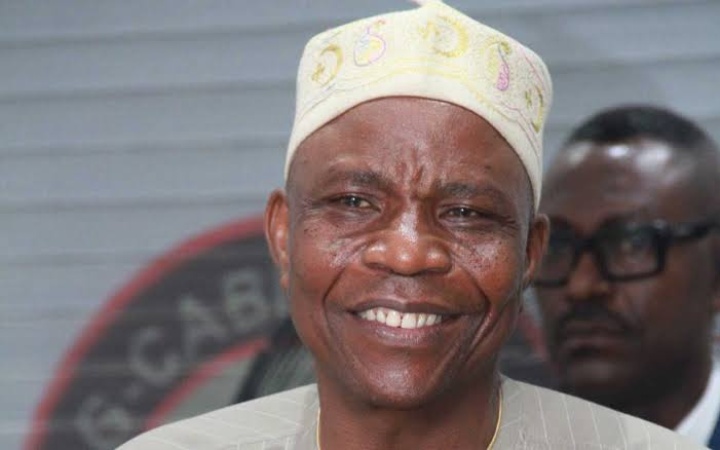


NBC Director General, Mr Charles Ebuebu
...Sets June 17 for nationwide rollout
Nigeria’s long-delayed Digital Switch-Over (DSO) programme will unlock about N605.2 billion in advertising revenue and generate more than $1 billion from digital spectrum auctions as the country accelerates plans to complete its transition from analogue to digital broadcasting, says the Federal Government.
Director-General of the National Broadcasting Commission (NBC), Charles Ebuebu, alongside Managing Director/Chief Executive Officer of Nigerian Communications Satellite (NIGCOMSAT) Limited, Jane Egerton-Idehen, disclosed this yesterday, during a joint media briefing in Abuja.
They said that the Federal Government’s renewed “Big Picture” strategy would create a commercially sustainable and technologically inclusive broadcasting system for the country.
The NBC DG said the nationwide launch of the new digital broadcasting framework is scheduled for June 17, 2026, while the final analogue switch-off has been fixed for December 31, 2028.
According to NBC, the DSO will unlock the N605.2 billion national advertising market through verifiable audience measurement, enabling broadcasters and content creators to access new revenue streams.
The Commission, however, said that the release of the 700MHz and 800MHz digital dividend spectrum is projected to generate over $1 billion in auction proceeds. which would be reinvested into digital infrastructure and rural broadband expansion.
It added that Nigeria’s creative economy, currently contributing about N5 trillion to the Gross Domestic Product (GDP) and employing over 4.2 million people, would benefit from a modern distribution platform capable of exporting local content across West Africa through NigComSat-1R.
The NBC noted that every naira invested in local content could generate a 2.5 times multiplier effect on the economy, citing UNESCO and Deloitte benchmarks.
Ebuebu, while defending the adoption of a hybrid Direct-to-Home (DTH), Digital Terrestrial Television (DTT) and Internet Protocol (IP)-based broadcasting architecture, said that Nigeria could no longer rely solely on terrestrial television to achieve nationwide digital access.
He maintained that the revised strategy aligns with the 2012 white paper on DSO, which recognised both terrestrial and satellite broadcasting standards as part of a converged national broadcasting framework.
Egerton-Idehen, however, raised concerns over the technical sustainability of the satellite infrastructure supporting the FreeTV platform.
She said that NIGCOMSAT had already secured a fully funded commercial backup satellite arrangement at the same 42.5° East orbital slot to prevent service disruption if NigComSat-1R experiences challenges.
The NBC DG, however, dismissed affordability concerns, saying the proposed FreeTV platform would not require monthly subscription fees and that open-standard DVB-S2 decoders are already available in the Nigerian market for between N15,000 and N25,000.
According to the NBC, discussions are ongoing on subsidy schemes and financing support for low-income households to ease the transition process.
The Commission said that the DSO would create significant opportunities for local set-top box manufacturers and assemblers due to the expected demand for millions of digital receiving devices over the coming years.
Ebuebu, who added that broadcasters joining the FreeTV platform would enjoy an 18-month free carriage window, said the digital platform is expected to provide more than 100 television channels, including dedicated indigenous language channels.
He, therefore, urged broadcasters, telecoms operators, signal distributors, advertisers, manufacturers and state governments to support the implementation process.
He disclosed that a national DSO stakeholders’ meeting would be convened within 30 days of the June 17 launch to address implementation concerns and deepen industry participation. (Guardian)