ADAD
ADAD
Updating your news feed...
NEWS EXPRESS is Nigeria’s leading online newspaper. Published by Africa’s international award-winning journalist, Mr. Isaac Umunna, NEWS EXPRESS is Nigeria’s first truly professional online daily newspaper. It is published from Lagos, Nigeria’s economic and media hub, and has a provision for occasional special print editions. Thanks to our vast network of sources and dedicated team of professional journalists and contributors spread across Nigeria and overseas, NEWS EXPRESS has become synonymous with newsbreaks and exclusive stories from around the world.






















Loading banners
Loading banners...

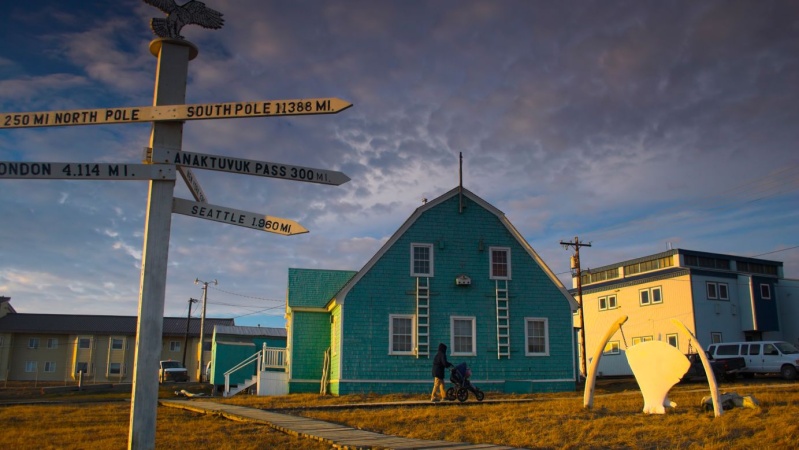
Standing on his back porch, Utqiaġvik native Robin Mongoyak reaches around a snow mound and pulls out a frozen caribou leg.
Now that temperatures are creeping above zero, he’s thinking about moving the delicacy into a vacuum-sealed bag and storing it in a “proper freezer” until it’s time to make caribou gravy — or aluutagaàq, a traditional Iñupiat dish.
As he speaks, he scans the bright sky for snow buntings — a sure sign that spring is well and truly underway in this remote corner of Alaska.
By mid-May, the black-and-white birds will be perched on rooftops and telephone poles, warbling away under the midnight sun.
“They are special, beautiful birds, but they start whistling, whistling, whistling, starting at dawn,” Mongoyak, an Iñupiat resident born in Utqiaġvik who runs Kiita Tours, tells CNN Travel over FaceTime.
It’s like a natural alarm clock — one of those things you get used to living at the “top of the world,” he quips.
Set between Arctic tundra and the icy ocean, Utqiaġvik, Alaska, is the northernmost city in the United States, home to about 4,500 people and accessible only by plane or summer barge.
It’s a place where Indigenous Iñupiat culture runs deep, families rely on the land and sea for sustenance, and the seasons matter more than the calendar.
“We’re living in two worlds now,” Mongoyak says. “We still hunt. We still eat our traditional foods. But we’re also working jobs, using technology, living a contemporary lifestyle.”
Now that it’s April, Utqiaġvik is settling into a bright — yet still chilly — spring after months of darkness.
Every November, the sun dips below the horizon and doesn’t return until late January, casting a deep blue glow over the town.
Temperatures can plunge to minus 50 degrees Fahrenheit (-45.56 C), though with the wind chill, Mongoyak says, it can feel closer to minus 90.
When the sun finally peeks above the horizon again in late January, the energy shifts dramatically.
“It just fills you up,” Corrine Danner, who was born and raised in Utqiaġvik’s Iñupiat community, tells CNN Travel. “It feels like we’re alive again.”
To celebrate the season, there are Iñupiaq dances and Easter festivities, as well as an annual spring festival called Piuraagiaqta (meaning “Let’s go out and play”), complete with scavenger hunts, ice golf on the frozen lagoon, card games and evenings around fire pits with s’mores.
“After being dormant for months, we’re all finally getting out, stretching our legs, and getting a little windburn on our cheeks,” Mongoyak adds.
Growing up in nature
Like Mongoyak, who spent his childhood pitching tents and hunting geese, Danner had a similar upbringing.
She was born in 1975 and recalls being raised in a world centered around the land and sea.
When Danner was young, her father — a whaling captain and serious subsistence hunter — was responsible for providing most of the family’s food.
Every year, he took his four children deep into the tundra to go ice fishing.
“We would go 50 miles out for weeks at a time,” Danner recalls. “Just us. No friends. No distractions. Nothing. Just the fish. We’d bring back about 100, then eat them throughout the winter.”
She also learned to hunt caribou and seal, and preserve the meat for winter. Then, come spring, it was time to hunt geese.
“That was the most fun — it was always so warm and sunny out,” says Danner, now a mother of eight. “We depended on what my dad caught, and whatever he brought home, my mom prepared.”
Her mother cooked traditional Iñupiat dishes such as aluutagaàq, which consists of caribou meat in gravy over rice.
As a treat, they’d slice off frozen slabs of caribou and dip them into seal oil. “It was simple,” Danner says. “But it was everything.”
Fast forward to today, and many households still rely on a mix of subsistence hunting and wages from full-time jobs.
Major employers include the North Slope Borough government, oil fields, local schools, the hospital and tribal organizations.
Salaries in Utqiaġvik are generally higher than the national averages — around $115,000 per household, compared with roughly $84,000 across the United States — but so is the cost of living.
Groceries are especially expensive: a dozen eggs costs roughly $5, a gallon of milk about $13, and a frozen pizza can run to more than $25.
Instead of filling her cart at the local store, Danner usually places bulk orders online from Costco, which are then shipped in.
The town is compact, with many essentials clustered together, and modern infrastructure has brought natural gas lines, electricity, internet and running water to most homes.
Right now, though, Mongoyak says housing shortages are a real issue.
“We’re actually overpopulated,” he says. “There are no houses available to rent or buy, and it’s very expensive to build here for the same reason we don’t have paved roads — all the materials and equipment have to be shipped in.”
In addition, permafrost makes building especially complex. Most homes must be constructed on stilts to prevent the home’s heat from thawing the ground below, which can lead to cracking and sinking.
Heading out into the wide open tundra, there are eight smaller villages scattered across the North Slope region.
While none of them are connected by roads, a seasonal Community Winter Access Trail enables people to travel by snowmobile or all-terrain vehicles across compacted snow. Flights remain the only year-round way in or out, and they are often delayed by fog, dust storms or blizzards.
“Sometimes the sky and the ground are the exact same color — it’s like looking at a blank sheet of paper,” Mongoyak says. “We call it Quvyuk, which means ‘whiteout conditions.’”
Oil development, Danner says, has brought a mix of economic opportunity and heated debate.
While the industry creates jobs and boosts tax revenue, it has also altered traditional caribou migration routes and raised concerns about the overarching environmental impacts.
“We’re getting a little more flexible about development,” Mongoyak shares. “Our ancestors were very adamant about protecting these lands because we depended on them for hunting and our traditional way of life.”
Still, he adds, development must be handled carefully.
“They have to do it the right way and make sure everything is clean and well managed,” he says.
“In some parts of the slope, people still live in very basic conditions. But thanks to infrastructure (funded by tax revenue from the oil fields), we have running water and flushing toilets. It has improved our lives, but they have to run the fields properly.”
Amid all the changes in recent decades, cultural traditions have stayed strong.
When he was younger, Mongoyak was an avid traditional dancer, performing all over Alaska and even at former President Bill Clinton’s inaugural parade in Washington, DC.
Though he no longer dances, there’s a community group that practices every night.
Above all, whaling is the most important part of the cultural identity, he says, and for many residents, the year still revolves around the spring and fall hunts. While commercial whaling is banned under US federal law, some indigenous communities in Alaska are permitted to hunt certain types of whales, primarily bowhead and belugas, for nutritional and cultural purposes.
“The whales travel right along the coastline,” says Mongoyak. “Our ancestors watched those movements for generations.”
To prepare, Iñupiat women sew umiaqs (skinboats) made from bearded seal skins that have been fermented for months, making the fur easier to remove.
The skins are then stretched and stitched slowly and carefully by hand with ivalu — a thread made from dried caribou tendon — then mounted on a boat frame to bleach in the sun.
“It can get super bright, bright white, almost the color of ice,” says Danner. “And then when you’re on the ice, it’s like a camouflage. The whales, they think it’s just ice.”
An avid seamstress, Danner learned the meticulous craft of skinboat sewing from her late sister, Doreen.
“She was actually a really mean teacher,” laughs Danner. “But I am very thankful she forced me to learn. Every time I sew something, she’s always with me in spirit.”
Come spring, whaling crews carve long pathways across the ice to the edge of the ocean before launching their boats into the water.
If they have a successful hunt, the prized muktuk — a delicacy of whale skin and blubber — is shared with everyone.
“We believe the whale gives itself to the crew so we can feed the community,” Danner says.
The rest of the catch is stored in icy underground cellars until Nalukataq, the annual blanket-toss festival held in June, when whaling families serve muktuk alongside geese, caribou and traditional dishes like akutuq, or Alaskan ice cream.
Whaling is also shifting as climate change reshapes Arctic conditions, says Danner. The water now freezes up later, and the ice itself is thinner and less reliable.
“We have to pay attention in a different way now,” she says. “But our people have always adjusted to the land. That’s how we’re still here.”
Mongoyak says that makes it harder to pass down some traditional skills and wisdom to younger generations.
“We teach our kids Arctic survival skills, but I am having a hard time teaching them about the ocean because it’s different now,” he says. “The climate has gotten warmer.”
For Danner, tradition is also sustained through sewing, teaching and speaking her native Iñupiaq whenever she can.
After work, she spends hours hand-crafting parkas trimmed with wolverine, wolf or silver fox — a precious skill she now shares with others in community workshops, incorporating Iñupiaq terms and phrases.
“We have been losing our language, but there’s been a push to preserve it,” she says.
After decades of being suppressed by missionaries seeking to promote English, the Iñupiaq language, along with stories and songs, is now taught in local schools, and residents like Danner and Mongoyak speak it whenever they can.
“You can hear Iñupiaq all the time. Not many of us are fully fluent, like the older generations were, but we still try to use it,” says Mongoyak.
Whether for jobs, nature or the slower pace of life, the town also draws people from all over the globe.
Growing up, Mongoyak says the population was roughly half Iñupiat and half non-Native residents.
Today, people in town come from South Korea, the Philippines, Hawaii and the “Lower 48” — the mainland US states.
“We’re ethnically rich — people from all kinds of backgrounds live here and coexist really well,” he says. “As far away as we are from the world, we’re not too far away from everybody.”
Shane Parker, a police sergeant and professional wildlife photographer who works in Utqiaġvik on two-week rotations, says that sense of community is one of the things he appreciates most.
“People really look out for each other here,” says Parker, who spends his off-weeks in Chicago. “It’s a small town — everyone knows everyone, and people are quick to help if someone needs it. And if you have the drive to be part of a community, you will be successful here.”
In terms of police work, “there’s not a whole lot going on day to day,” he adds.
Parker’s calls most often include illegal alcohol importation — Utqiaġvik is a “damp” town where alcohol sales are banned, and most of the surrounding villages are dry — along with domestic disputes, loose dogs and noise complaints about racing ATVs.
As a photographer, he’s also enthusiastic about the region’s natural draws. Two years into working in Utqiaġvik, the encounters can still feel surreal at times.
“The first time I went to ‘The Point’, I was just in awe,” he says.
About nine miles up the coast, Point Barrow, the northernmost tip of the United States, sits along a sandy spit, surrounded by water.
From the headland, Parker has photographed polar bears dining on whale carcasses, Arctic foxes darting between snow banks, and the occasional snowy owl perched on the brown tundra.
And while the cold can “feel like needles in your skin,” Parker insists the long dark winter isn’t as oppressive as you might imagine.
“For about an hour and a half every day, there’s a glow on the horizon, like a sunset or sunrise,” he says.
Then there are the packed basketball games at the local high school and the northern lights dancing across the sky.
“The lights aren’t just on the horizon — they are completely overhead, stretching from one side to the other,” he says. “Watching that with your naked eye is an experience. It’s really moving.”
While winter has its wonders, most visitors head to Utqiaġvik during the warmer summer months, though “warmer” here means temperatures averaging around 40-50 degrees.
Birders arrive to watch thousands of king eiders migrate across the sky, while other intrepid travelers come to camp on the tundra and explore the Arctic coastline.
Mongoyak hopes to share more of his Indigenous culture and traditions, as well as the area’s beauty, through his small-group tours.
“When people first arrive, they sometimes think there’s nothing here,” he says with a laugh. “But once you spend a few days, you realize just how much there is to see and do and learn.”
There’s the whale bone arches, the Iñupiat Heritage Center, ancient archaeological sites and wildlife photography or birding tours across the Arctic landscape.
Back in town, everyday scenes can be memorable, too.
You may spot used four-wheelers ripping down the gravel roads or the occasional polar bear drawn by the scent of drying seal skins.
“Don’t be afraid if you see someone skinning a caribou outside their house,” says Danner. “You can usually go up, ask questions and watch. People are happy to share.”
It’s these quirks, traditions and warmth, says Mongoyak, that keep people coming back. Even young people who leave for school or jobs often return — himself included.
“I tried living in other places,” he says. “Hawaii, Southeast Alaska, Anchorage. But I was magnetically compelled to come back.”
It feels fitting, he adds, since the town’s name, Utqiaġvik, is often described locally as meaning “a place to return to” — a nod to the Iñupiat tradition of seasonal travel across the Arctic before coming home.
“No matter where we go,” he says, “it will always be a place to come back to.” (CNN)