ADAD
ADAD
Updating your news feed...
NEWS EXPRESS is Nigeria’s leading online newspaper. Published by Africa’s international award-winning journalist, Mr. Isaac Umunna, NEWS EXPRESS is Nigeria’s first truly professional online daily newspaper. It is published from Lagos, Nigeria’s economic and media hub, and has a provision for occasional special print editions. Thanks to our vast network of sources and dedicated team of professional journalists and contributors spread across Nigeria and overseas, NEWS EXPRESS has become synonymous with newsbreaks and exclusive stories from around the world.




.webp)



Loading banners
Loading banners...

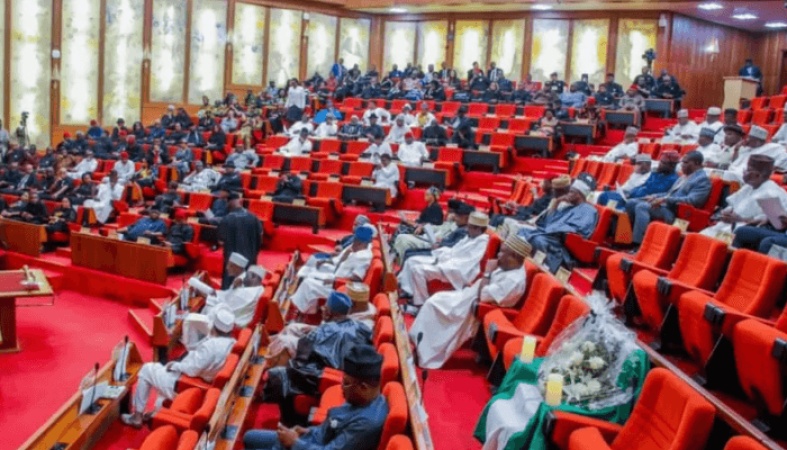
Nigerian Senate
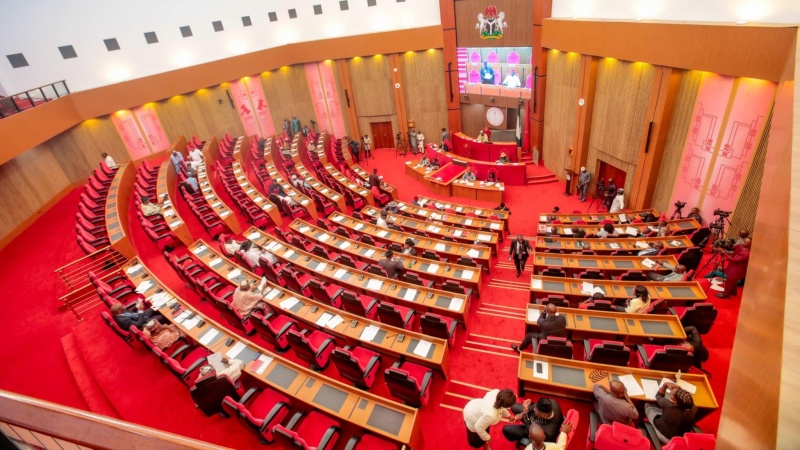
After weeks long recess, the National Assembly resumed plenary on Tuesday to a chamber already overtaken by events. The echo of the chamber is loud as empty red seats convey without doubt that there is no interest in legislative business at the moment, as it is the season of politicking.
Barely forty-eight hours from now, political parties will open their primaries, the most decisive phase of the electoral cycle, where political careers are secured or abruptly ended. It is this collision, between legislative duty and political survival, it was gathered, that defines the senate’s return.
There is no immediacy to the primaries, neither is it incidental. It is as structured by the timetable of the Independent National Electoral Commission (INEC), which has compressed the pre-election calendar in a way that leaves lawmakers with little room to separate governance from politics, based on the Electoral Act passed by them.
Party primaries, scheduled between April 23 and May 30, place senators at the very centre of electoral contestation almost as soon as they take their seats on resumption from the Easter break. What would ordinarily be a period for legislative recalibration has instead become the opening act of a high-stakes political season.
A Legislature with Too Many Breaks
The senate’s resumption comes against the backdrop of a legislative calendar already marked by irregularity. In the first quarter of 2026, lawmakers sat for just 17 days, underscoring the extent to which observers say, plenary activity has been disrupted by adjournments, recesses, and misplaced priorities.
Daily Sun recalls that since the inauguration of the 10th National Assembly on June 13, 2023, data from the Policy and Legal Advocacy Centre (PLAC) indicates that lawmakers have spent 581 out of 1,003 days on recess, sitting for only 422 days. The ratio tells its own story, a legislature more frequently absent than present.
The pattern has persisted into 2026. Following their return from the Christmas and New Year break on January 27, plenary was quickly adjourned to allow committees to handle budget defence sessions tied to the 2026 Appropriation Bill. What followed was a sequence of postponements, first to February, then to early March, compressing legislative work into a narrow and fragmented window.
Even when lawmakers reconvened, their focus remained episodic. They returned briefly to pass the Electoral Act 2026, adjourned again, reconvened to pass the N68.32 trillion Appropriation Bill, and then proceeded on Easter recess.
By the time the senate resumed on Tuesday, the cumulative effect of their frequent absence was clear. Legislative activity has gone under and the race to meet the minimum calendar days very near lost.
Daily Sun gathered that this pattern raises a more fundamental concern. Under Section 63 of the 1999 Constitution, the National Assembly is required to sit for not fewer than 181 days in a year. By the end of March 2026, lawmakers had recorded just 17 sitting days out of a possible 90.
To meet the constitutional threshold, the Assembly would need to sit for at least 164 additional days before the end of the year, a target that now appears increasingly unrealistic.
The difficulty is not merely logistical. It is political
With primaries commencing immediately after resumption and campaigns scheduled to begin in August, the legislative calendar is being overtaken by electoral imperatives. The window for sustained parliamentary work is narrowing, even as national challenges demand consistent attention.
Primaries as the Real Contest
Within Nigeria’s electoral framework, party primaries are often more decisive than the general election itself. They determine who appears on the ballot, and in many constituencies, that effectively determines who wins. For senators, therefore, this makes the April to May primaries existential.
Securing a return ticket requires more than legislative performance. It demands control of party structures, alignment with influential stakeholders, and mobilisation of delegates. These processes are intensive, requiring sustained presence in constituencies and constant engagement with political actors.
The implication for governance is immediate. Lawmakers are compelled to divide their attention between Abuja and their states, between legislative obligations and political negotiations that cannot be postponed.
Governors and the Politics of Control
Layered onto this dynamic is the influence of state governors, who remain central to the outcome of party primaries. In many states, governors shape the composition of party executives and the selection of delegates, giving them decisive leverage over who emerges as candidates. This places several senators in direct or indirect contest with their own state structures.
Figures such as Enyinnaya Abaribe in Abia, Gbenga Daniel in Ogun, Francis Fadahunsi in Osun, Ovie Omo-Agege in Delta, and Ibrahim Gobir in Sokoto operate within political environments where gubernatorial influence is a critical variable. Their prospects are shaped largely by personal political capital, but also by how effectively they navigate relationships within their parties.
The influence of the governors is public and consequential. They determine not only candidacy, but continuity in the senate. For some, the die is cast as the governors move to take over in the Red Chamber as their tenures come to an end.
At the same time, a number of senators are not seeking return at all, opting instead to pursue governorship ambitions. This trend reflects a broader shift in the senate’s role, from a destination to a launchpad. Some senators such as Solomon Adeola, Adetokunbo Abiru, and Aliyu Wadada have been linked to governorship races, signalling a deliberate move away from legislative careers. Others are already the subject of endorsements encouraging them to contest.
These ambitions further thin the senate’s focus. Governorship bids require statewide mobilisation, expanding political activity beyond senatorial districts and intensifying the demands on lawmakers’ time.
Committees Close as Political Activities Kick Off
The overlap between legislative duties and electoral activity is already visible in the slowing pace of work within the National Assembly. Observations indicate reduced attendance at plenary sessions and declining committee activity, as lawmakers prioritise political engagements in their constituencies.
The consequences are already evident in policy outcomes. The 2026 budget was passed well into the fiscal year, reducing its effectiveness as a planning instrument. Constitutional amendment processes initiated in 2024 remain unresolved, despite an earlier deadline of December 2025.
Key proposals, including state policing, judicial reforms, and special seats for women, have yet to receive plenary consideration.
These delays are not isolated incidents. They reflect a broader pattern in which legislative work is repeatedly interrupted, compressed, and deferred.
With campaigns for National Assembly elections set to begin in August and elections scheduled for January 2027, the pressure on the legislative calendar will only intensify. The political conditions challenge institutional capacity – Lawmakers are expected to legislate, oversee, and represent, even as they navigate primaries, campaigns, and intra-party negotiations.
The tension between these roles is not new, but the current electoral timetable has made it more immediate and more difficult to manage.
For the Senate, the coming months represent a test of balance. The constitutional mandate remains unchanged, but the political environment has shifted dramatically. What has emerged is a legislature operating under sustained electoral pressure, where governance and politics are no longer sequential phases but overlapping realities.
The question is not whether the senate will continue to function. It will. The concern is how effectively it can do so with legislative depth, consistency, and accountability.
The gavel has signalled resumption of plenary and other legislative activities, but in practical terms, the senate is in the midst of its most defining contest for political survival ahead of 2027 as senators jostle for tickets to return back to their seats. (The Sun)