 ADAD
ADAD
Updating your news feed...
NEWS EXPRESS is Nigeria’s leading online newspaper. Published by Africa’s international award-winning journalist, Mr. Isaac Umunna, NEWS EXPRESS is Nigeria’s first truly professional online daily newspaper. It is published from Lagos, Nigeria’s economic and media hub, and has a provision for occasional special print editions. Thanks to our vast network of sources and dedicated team of professional journalists and contributors spread across Nigeria and overseas, NEWS EXPRESS has become synonymous with newsbreaks and exclusive stories from around the world.

















Loading banners
Loading banners...

The emergence of Prof. Ursula Ngozi Akanwa as the 7th Vice-Chancellor of Michael Okpara University of Agriculture, Umudike, on February 20, 2026, naturally invites a new reflection on the long-standing assertion that women are largely absent from university leadership in Nigeria in the 21st century.
A closer look at developments over the past decade reveals a gradual but unmistakable shift; while women remain few at the helm of Nigerian universities, a change is happening, and if current trends continue, their numbers are likely to increase as broader social transformations reshape leadership spaces.
For much of Nigeria’s post-independence history, the office of Vice-Chancellor was mostly occupied by men. Women were visible in academia as lecturers, researchers and professors, but they were seldom entrusted with the apex executive authority of universities. Since 1960, only about 38 women have ever held the position of Vice-Chancellor nationwide; this is a stark indicator of entrenched gender imbalance in higher education governance.
However, the period from 2016 to 2026 marks a significant change in the number of women taking leadership roles in Nigerian universities. While women still account for only a small fraction of Vice-Chancellors nationwide, the number of appointments within this period is significantly higher than in earlier decades.
Since 2016, at least 19 women have served or are serving as Vice-Chancellors across federal, state, and private universities in Nigeria and this is a marked increase compared to the sparse representation recorded before the mid-2010s. Despite this progress, the overall proportion remains modest when measured against the 307 approved universities currently operating in Nigeria. Even with these 19 appointments over the last decade, women still constitute well below 10% of total university leadership at any given time.
Nevertheless, the concentration of these appointments within a single decade points to a structural shift. What was once a rare occurrence has become increasingly visible and this suggests that the pattern of female exclusion from apex university governance is gradually giving way to a more inclusive, merit-based leadership landscape.
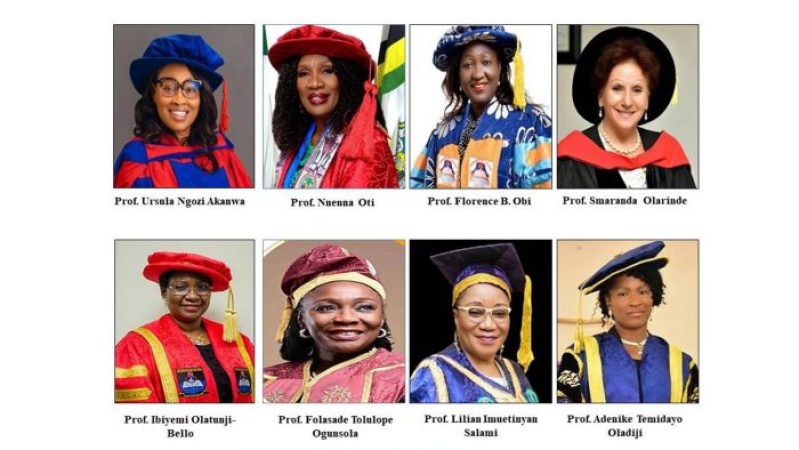
High-profile breakthroughs illustrate this momentum. At the University of Benin, Prof. Lilian Salami assumed leadership. The University of Calabar appointed Prof. Florence Obi, breaking a 45-year male-only streak. The Federal University of Technology Owerri saw Prof. Nnenna Oti emerge as Vice-Chancellor, while the University of Lagos appointed Prof. Folasade Ogunsola as its first female VC. Similarly, the Federal University of Technology Akure appointed Prof. Adenike Oladiji.
The latest is Professor Ursula Ngozi Akanwa who assumed office as the 7th Vice-Chancellor of Michael Okpara University of Agriculture, Umudike (MOUAU) on March 1, 2026, following the university’s Governing Council approval at its 95th meeting held on February 20, 2026, marking a historic milestone as the first female to lead the 34-year-old federal institution. These developments signal that the “glass ceiling” in Nigerian academia, though not fully dismantled, is visibly cracking.
Female Vice-Chancellors in Nigeria (2016–Present)
Below is a consolidated list of women who have served as Vice-Chancellors in Nigerian universities from 2016 to date:
Prof. Fatima Batul Mukhtar: Vice-Chancellor, Federal University Dutse (2016–2021); later pioneer VC, Azman University Kano (2023)
Prof. Angela Freeman Miri: Vice-Chancellor, Federal University Lokoja (2017–2021)
Prof. Victoria Adaobi Obasi: Vice-Chancellor, Imo State University (2017–2020)
Prof. Smaranda Olarinde: Vice-Chancellor, Afe Babalola University (from 2020)
Prof. Omolola Irinoye: Vice-Chancellor, Achievers University (appointed 2023)
Prof. Lilian Imuetinyan Salami: Vice-Chancellor, University of Benin (from 2019-2024)
Prof. Florence B. Obi: Vice-Chancellor, University of Calabar (from 2020–2025)
Prof. Ibiyemi Olatunji-Bello: Vice-Chancellor, Lagos State University (from 2021)
Prof. Nnenna Oti: Vice-Chancellor, Federal University of Technology Owerri (from 2021)
Prof. Kaletapwa G. Farauta: Vice-Chancellor, Adamawa State University (from 2017-2022)
Prof. Adenike Temidayo Oladiji: Vice-Chancellor, Federal University of Technology Akure (from 2022)
Prof. Folasade Tolulope Ogunsola: Vice-Chancellor, University of Lagos (from 2022)
Prof. Bidemi Lafiaji-Okuneye: Vice-Chancellor, Lagos State University of Education (from 2023)
Prof. Enase Felicia Okonedo: Pan Atlantic University (from 2022)
Prof. Stella Chinye Chiemeke: Vice-Chancellor, University of Delta (from 2021)
Prof. Eunice Eboserehimen Omonzejie: Vice-Chancellor, Ambrose Alli University (appointed 2025)
Prof. Chinedum Peace Babalola: Chrisland University (2017-2024)
Prof. Adenike Kuku: Kings University (2021-2026)
Prof. Ursula Ngozi Akanwa: Vice-Chancellor, Michael Okpara University of Agriculture, Umudike (appointed 2026)
The increasing presence of women in university leadership in Nigeria reflects broader societal evolution.
Educational attainment among women has improved significantly over the decades, producing a pool of highly qualified female scholars with rich research portfolios and administrative experience. Selection processes appear gradually shifting toward merit, competence, and institutional vision rather than entrenched gender assumptions.
The implications are also generational.
Representation influences aspiration. When female academics and students witness women leading large and complex institutions, it redefines the boundaries of possibility and challenges outdated leadership stereotypes. Over time, this may deepen the pipeline of women prepared for executive governance in academia.
However, realism remains essential. With women still accounting for less than 10 per cent of Vice-Chancellors nationwide, parity is distant. Progress remains incremental and will require sustained institutional reforms, transparent appointment procedures, and leadership development pathways.
For Michael Okpara University of Agriculture (MOUAU), Prof. Akanwa’s appointment carries strategic weight. She is a distinguished Professor of Educational Measurement and Evaluation and immediate past Deputy Vice-Chancellor (Research and Development) of the institution, who brings over three decades of academic and administrative experience.
Having served as both Dean and Head of Department also, she understands the university well and has strong academic experience. Her leadership is expected to provide stability, promote research-focused management, and improve academic quality standards.
The increase in the number of female Vice-Chancellors in Nigeria is more than just a symbol. It shows a society that is slowly but steadily changing how it sees leadership. Although the number of women in these roles is still small, the trend indicates that women leading universities are becoming more common and their presence is starting to make a real impact. (Guardian)



