 ADAD
ADAD
Updating your news feed...
NEWS EXPRESS is Nigeria’s leading online newspaper. Published by Africa’s international award-winning journalist, Mr. Isaac Umunna, NEWS EXPRESS is Nigeria’s first truly professional online daily newspaper. It is published from Lagos, Nigeria’s economic and media hub, and has a provision for occasional special print editions. Thanks to our vast network of sources and dedicated team of professional journalists and contributors spread across Nigeria and overseas, NEWS EXPRESS has become synonymous with newsbreaks and exclusive stories from around the world.















Loading banners
Loading banners...

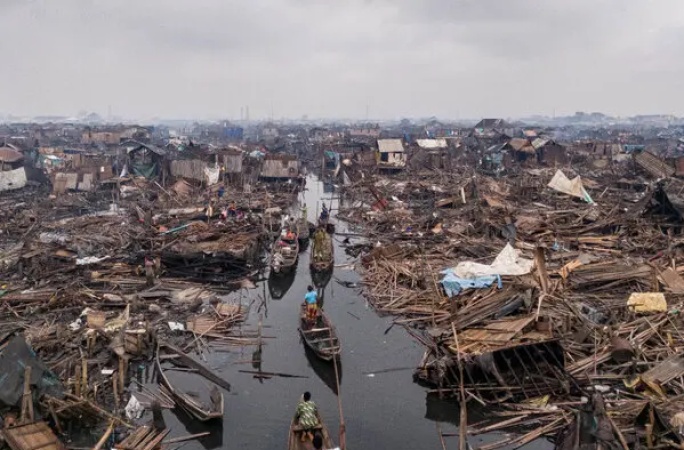
Demolished Makoko community
It is just a stroke of luck or probably divine mercies that Ebikamo Eruwari, a 72-year-old retiree, survived death after his home was demolished in Makoko, a slum waterfront community in Lagos.
Originally from Sagbama in Bayelsa State, Eruwari, who came to Lagos in his teens, has lived all his life at Makoko. Sadly, his two-bedroom house, built from his 30 years meritorious service at Julius Berger, and the place he once called home, was reduced to rubbles following a state-backed demolition exercise.
The retiree, who now stays with his daughter, a police officer, at Bariga, is still nursing his wound and loss, amid a potential health challenge.
While Eruwari is lucky to find succor, many displaced Makoko residents are still out there, with no shelter, vulnerable and abandoned. Some died during the demolition, and others have developed some health challenges since then.
The story of Elizabeth Etete, a mother of three, who used to run a mobile local restaurant on Makoko waters, says it all.
Etete is left with just her canoe after the demolition of their stilt house, built by her runaway husband. Since the sad experience, the canoe has been their home, as few properties she managed to rescue are all inside the canoe, where she and her children also sleep.
Of course, Etete’s children have not been back to school since the demolition as the cheap school they attend, which was built on a floating platform, was also destroyed.
The dilemma for many displaced families is that house rent in the nearby Yaba, Iwaya, Akoka and Bariga is far out of their reach, while school fees in most private schools around are equally exorbitant, leaving them to government schools that are already choked up.
“What we need now is shelter and food. My children can go back to school when things improve,” she decried, while speaking the mind of the many concerned mothers and displaced families.
Reviewing the case, Agnes Onche, a retired director in the Federal Ministry of Education and now a school proprietress, decried that the Makoko situation, like the persisting kidnaping of school girls, would impact on out-of-school children rate, which is already high.
“Alternative learning spaces and health facilities should be given priority in whatever solution the Lagos State government or NGOs are bringing to the Makoko community,” Onche said.
“If those displaced children cannot go to school again, those among them who lost their breadwinners, and those who lost their homes are likely going to be the terror of tomorrow. Let’s show them love now, reabsorb them and provide alternative homes, occupations and lifestyle to the displaced to forestall future disaster.
“If we fail, they will find their way around, but will be out of control and potential for terror groups. That is how Almajiri started and we all know the issue today”
But the worry for Ehitayo Idris, a university don, is that whether the demolition was necessary for safety and urban renewal reasons as insisted by the Lagos State government or is a state-sanctioned oppression of the poor, as many noted, the deed had been done, while the victims are bearing their pain and losses alone.
“Yes, they have halted the demolition, but what about lives that were lost, homes and properties destroyed by the state actors. The government has not even regretted its action, but is busy justifying the demolition. I think that the displaced should be housed by the government, pending when their homes are rebuilt or alternative provided,” Idris said.
He is even more worried than the residents whose houses are still intact, as what the government did was just halting the demolition exercise, which can commence anytime.
“How do you expect the residents to sleep with their eyes closed. Anything can happen, the Oworonshoki demolition was at night and when the bulldozers return to Makoko, arm-wielding security operatives will follow to intimidate people and sadly in a democratic era,” he lamented, expressing grave concern for the remaining residents.
Beyond the destroyed homes and displacement, Olayinka Babalola, a documentary filmmaker, decried that it is not just buildings, but livelihoods and culture are being wiped out by the demolition in Makoko.
“They have their own culture. They have their own language. They have their own schools. They have their own economy right there in the city. It’s almost like a self-sufficient system.”
In a recent interview on her latest documentary on Makoko, she frowned on how the complex and self-sustaining community is often reduced to a caricature of poverty, when in reality it is a culture powerhouse.
Considering that Makoko residents have a unique culture, their own language, special schools and a thriving economy, she described the community as a self-sufficient system, which should be preserved instead of the demolition.
She also insisted that the impression that Makoko is as a slum with dirty water and unsafe canoes is wrong, noting that a visit will always reveal how different the community is and aways from the negative narrative being sold to the world.
“The residents have been impacting the economy with lots of trade that happens in the fishing village. They fish, sell, bring back food and impact the Lagos economy,” she said.
In the same vein, Ibijie Ogbere, a Lagosian, who is proud of his Ilaje heritage, decried that destroying Makoko means wiping out colourful cultures of the Ilajes and Ijaws that dominate the community.
“The stilt house you see and other things floating on water are Ilaje and Ijaw heritages,” Ogbere said. “For us, Makoko is a fishing village that supports livelihood on water, a home, and a heritage. If you destroy it, you also destroy the heritage because you will not witness our naming ceremonies again, fishing festivals, and traditional worship, which must all happen on water”.
Meanwhile, some unscrupulous non-governmental organisations (NGOs) are taking advantage of the situation to seek relief packages from donor agencies for the displaced.
Some residents are getting calls from certain quarters, requiring clarifications on the impact of the demolitions, which are courtesy of some unscrupulous NGOs, which are trying to play a fast one on willing donors for the displaced.
The development has also made some of the victims to urge the Lagos State Government to provide a clear relocation plan as compensation for properties destroyed during the demolition exercise, just as the Lagos State House of Assembly ad-hoc committee set up by Mudashiru Obasa, the speaker, has also concluded its investigation into the demolition.
At the committee’s final meeting on Thursday, representatives of the three communities expressed differing positions on compensation and relocation for residents affected by the exercise, while Noheem Adams, the Majority Leader of the Assembly, expressed concern over the shifting positions of community representatives.
He recalled that the communities had earlier agreed on compensation but later changed their stance, describing the development as a setback to the reconciliation process. According to him, the committee would report its findings and the communities’ positions to the Speaker and the entire 40-member Assembly for further deliberation.
However, a resident who pleaded anonymity told BusinessDay that the affected communities have been asked to come up with a 30-man committee to interface with the government. “They have stopped the demolition for now and they requested some of our members to give them a list of 30 members.”
The concerned resident, who is a teacher, said the government has assured residents of plans to regenerate the entire Makoko community. “What they are saying is that they are going to build some houses on the water to accommodate some people, while some will be given compensation and they will leave the community,” he said.
However, he added that the uncertainty surrounding the situation is also giving some of the residents’ fear of further demolition later in the future. “We don’t know how true this will be; until I see it, but that is what they have been saying for now,” the teacher said.
Another resident who identified as Pastor Ogbokunnu Daniel told BusinessDay that the situation remains unclear with residents unsure of the government’s position on their situation. “We have been living on the water for some time now and sometimes seek refuge in nearby schools.
“I cannot enjoy life with my children the way we used to do. Now we are like slaves, if we go to bed at night – we wake around 5am because of the uncertainty surrounding the community. At the moment we do not have a place to stay,” Daniel said.
However, some Lagosians are also of the view that a state aiming to become a megacity cannot afford to have a slum as large as Makoko. “Makoko should not have happened in the first place. It was a catastrophic gravitational attraction and coalescence of people at the extreme lower end of the societal ladder that resulted in a massive slum,” Moses Lawal, a Lagos-based public commentator, told BusinessDay.
As the unfortunate community grew, so did interest in it from near and far. While perhaps the government “looked away” from the burgeoning blight, NGOs and content creators found a goldmine there. Its unique location made it conspicuous.
“Some even dubbed it the “Venice of Africa”. But then, people living so conspicuously in squalor put a moral and safety burden on the shoulders of the government. An action needed to be taken to avert looming disaster,” Lawal said.
According to him, the number of people that would be displaced increased as the government wasted time in making a decision. “Personally, I feel the issue of Makoko should not have been allowed to linger this long. As the Lagos State Government fiddled, Makoko became a more established and more difficult issue to solve.
“As the LASG started the demolition, then later made the announcement that it had earmarked $2million to build a water city from Makoko, I agreed that it would end up a win-win situation eventually,” Lawal said.
He also believes the stoppage is temporary and that the state will more likely resume demolition sometimes in the future. “Maroko equally used to be a blight on the city of Lagos. After the demolition of Maroko came the Oniru and Lekki Peninsula from its ruins- which are places of pride to the city and country.
“Makoko must equally follow a similar trajectory and transit from being a blight to a pride. I eagerly look forward to that transition,” Lawal said, adding that gentrification can be a painful part of development, however it is sometimes inevitable. (BusinessDay)



