ADAD
ADAD
Updating your news feed...
NEWS EXPRESS is Nigeria’s leading online newspaper. Published by Africa’s international award-winning journalist, Mr. Isaac Umunna, NEWS EXPRESS is Nigeria’s first truly professional online daily newspaper. It is published from Lagos, Nigeria’s economic and media hub, and has a provision for occasional special print editions. Thanks to our vast network of sources and dedicated team of professional journalists and contributors spread across Nigeria and overseas, NEWS EXPRESS has become synonymous with newsbreaks and exclusive stories from around the world.






















Loading banners
Loading banners...

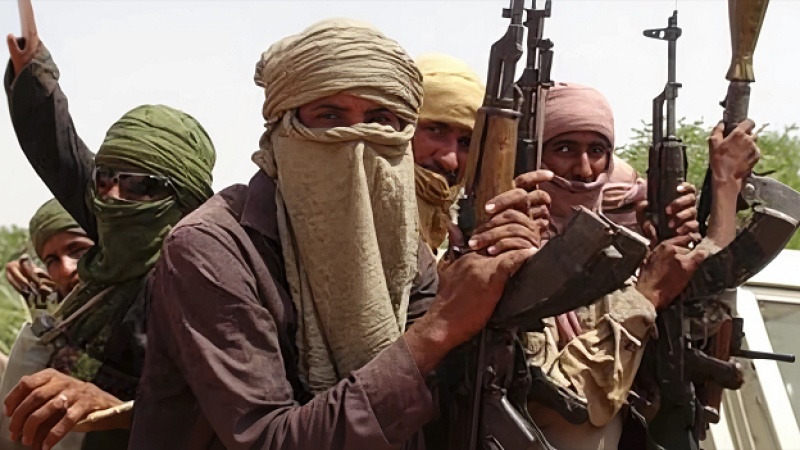
File photo of terrorists
Violent attacks linked to al-Qaeda-affiliated Jama’at Nusrat al-Islam wal-Muslimin (JNIM) and the Islamic State Sahel Province (ISSP) surged sharply across the border areas of Nigeria, Benin Republic and Niger Republic in 2025, according to a new report by the Armed Conflict Location and Event Data Project (ACLED).
The report shows that when 2024 and 2025 figures were compared, fatalities linked to militant violence in the tri-border zone jumped by 262 per cent. It also found that parts of Benin and Niger, as well as Nigeria’s Sokoto, Kebbi, Niger and Kwara states, accounted for an 86 per cent rise in recorded violent incidents.
In the report released yesterday, ACLED’s senior analyst for West Africa, Héni Nsaibia, said the threat posed by extremist groups in the area had evolved as militants expanded their reach.
“The threats have taken on new dimensions as these groups continue to expand their footprint,” Nsaibia said.
The findings highlight the accelerating spread of jihadist groups across West Africa, where governments and foreign militaries have struggled for more than a decade to contain their advance.
According to the assessment, both JNIM and ISSP adopted more visible and strategic communication tactics to demonstrate their ability to maintain influence and compete for relevance in the borderlands.
ACLED noted that between June and November 2025, JNIM publicly claimed many attacks in Basso, Wara, Nuku and Karunji along the Benin–Nigeria frontier.
The report said the claims marked some of the group’s first acknowledged operations inside Nigeria and represented “a public declaration of presence in an area where activity had previously been suspected but remained less overt”.
In a similar development, ISSP began formally claiming responsibility for attacks in Goubey and Birni N’Konni, located along the Niger–Nigeria border, in December and February.
Before these claims, the report said, violence in the area had largely been attributed to the Lakurawa armed group.
ACLED linked the expanding militant activity to weak governance and fragile regional cooperation, noting that “limited state presence and weak border control persist after many Sahelian states withdrew from Economic Community of West African States (ECOWAS), which led to weakened regional cooperation, bilateral tensions and limited cross-border coordination”.
The report also highlighted the role of the United States in recent counter-terrorism operations. It recalled that in December, the U.S. carried out precision strikes on two Islamic State enclaves in Sokoto, with the approval of the Nigerian government.
According to ACLED, Washington’s decision to target ISSP inside Nigeria, outside the group’s traditional strongholds in the central Sahel, reflected an attempt to halt its movement towards coastal West Africa while preserving U.S. strategic presence in the region.
“A more immediate trigger for the strikes may have been ISSP’s October kidnapping of U.S. citizen, missionary and civilian pilot, Kevin Rideout, in Niger’s capital, Niamey,” the report stated.
Beyond the abduction, ACLED said growing military cooperation between Nigeria and the U.S. provided a practical platform for confronting Sahel-based jihadist groups, especially as Western forces have been largely pushed out of countries at the centre of the region’s insurgency. (The Guardian)