 ADAD
ADAD
Updating your news feed...
NEWS EXPRESS is Nigeria’s leading online newspaper. Published by Africa’s international award-winning journalist, Mr. Isaac Umunna, NEWS EXPRESS is Nigeria’s first truly professional online daily newspaper. It is published from Lagos, Nigeria’s economic and media hub, and has a provision for occasional special print editions. Thanks to our vast network of sources and dedicated team of professional journalists and contributors spread across Nigeria and overseas, NEWS EXPRESS has become synonymous with newsbreaks and exclusive stories from around the world.

























Loading banners
Loading banners...

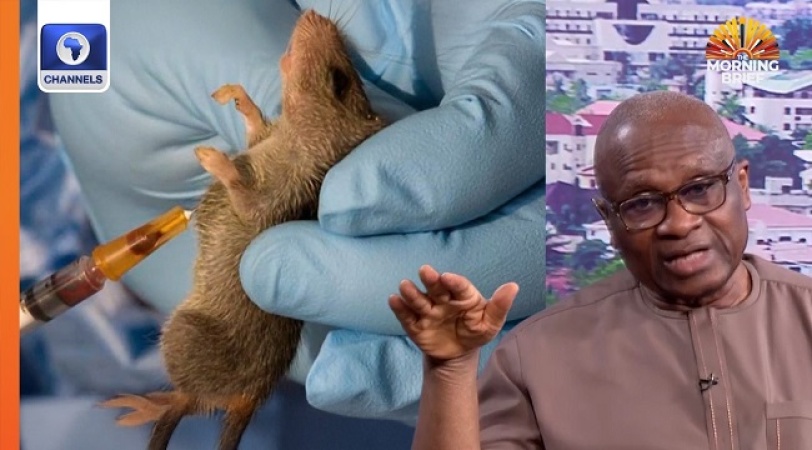
The Director-General of the Nigeria Centre for Disease Control (NSDC), Dr. Olajide Idris, has said the agency aims to reduce the incidence of Lassa fever to an appreciable level within the next 10 years.
Idris made this known during an interview on Channels Television’s The Morning Brief on Monday, explaining that vaccine development for Lassa fever takes time.
“We would reduce the incidence of Lassa fever to an appreciable level in the next 10 years. I said that because developing a vaccine for Lassa fever takes a long time.
“I am not going to lie to you telling you I’m going to reduce Lassa fever in the next two to three years whether I say that I will reduce the incidence of Lassa fever in this country appreciably to an attemptable level,” he said.
The Director-General noted that the death rate remains high and that efforts are underway to bring it down to less than 10 per cent.
He said a group of experts is working on vaccine development in collaboration with colleagues and stakeholders from parts of Africa and outside the continent.
“If I tell you I would stop Lassa fever in the next five years, I would be lying to you because it’s not only a health issue, it is an environmental issue, an animal issue and we need to deal with those rats that carry the virus,” he added.
Idris stressed that Lassa fever can be treated if patients present early at healthcare facilities.
“Lassa fever can be treated if people present early to health care facilities. It presents like normal malaria and starts treating until they start seeing the terrible symptoms like bleeding, that it’s called the hemorrhagic fever.
“But most importantly, the people who contract this disease do not report on time and the longer you wait, the more fatal it can be.”
According to him, about five states account for nearly 90 per cent of reported cases, which he described as alarming.
“That’s why we sent out our teams again to support this states to find out what could be going on, what they are doing right or wrong,” he said.
He added that certain gaps were identified and teams were redeployed to train personnel on case management. He noted that some states have treatment centres that are not adequately manned, some lack treatment centres entirely, and others do not know how to manage the cases.
Idris said advisories have been sent to states and that the agency has been engaging commissioners of health across the country.
“One of the problems occurs within local governments and states and that’s why states are being encouraged again to establish or build up the capacity for emergency preparation and response,” he explained.
He also highlighted the importance of infection prevention and control measures for health workers.
“That is what they call the infection prevention and control, what to wear to protect your self, either google, face mask, hand gloves, etcetera.”
The NCDC has confirmed 318 cases of Lassa fever and 70 deaths nationwide since the beginning of 2026.
Dr. Idris disclosed that 1,469 suspected cases have been recorded, resulting in a case fatality rate of 22 per cent.
He said five states — Edo, Ondo, Taraba, Bauchi and Ebonyi — account for 91 per cent of confirmed cases, while 10 local government areas account for 68 per cent of infections.
Lassa fever is an acute viral haemorrhagic illness caused by the Lassa virus, a member of the arenavirus family. It is an animal-borne disease transmitted by the common African rat, also known as the Mastomys rat.
The disease is endemic in Nigeria and other parts of West Africa. Humans are typically infected through exposure to food or household items contaminated with the urine or faeces of infected Mastomys rats. (Channels)



