ADAD
ADAD
Updating your news feed...
NEWS EXPRESS is Nigeria’s leading online newspaper. Published by Africa’s international award-winning journalist, Mr. Isaac Umunna, NEWS EXPRESS is Nigeria’s first truly professional online daily newspaper. It is published from Lagos, Nigeria’s economic and media hub, and has a provision for occasional special print editions. Thanks to our vast network of sources and dedicated team of professional journalists and contributors spread across Nigeria and overseas, NEWS EXPRESS has become synonymous with newsbreaks and exclusive stories from around the world.


























Loading banners
Loading banners...

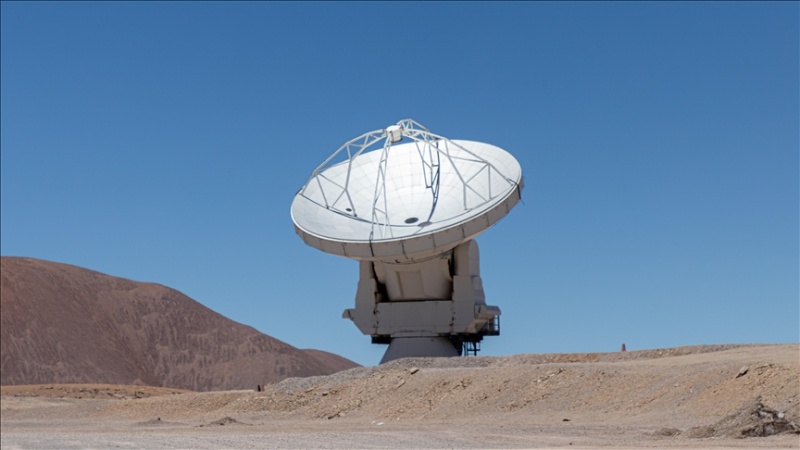
Astronomers using South Africa’s MeerKAT radio telescope have discovered the most distant hydroxyl megamaser ever detected.
It is described as “a record-breaking cosmic laser” over eight billion light-years away.
The discovery was announced in a statement issued on Tuesday by the South African Radio Astronomy Observatory (SARAO).
“It is located in a violently merging galaxy more than eight billion light-years away, opening a new radio astronomy frontier,’’ the observatory said.
Hydroxyl megamasers are natural “space lasers” extremely bright radio-wavelength emissions produced when hydroxyl molecules in gas-rich, merging galaxies crash into one another, SARAO explained.
These cosmic collisions compress gas and stimulate large reservoirs of hydroxyl molecules to amplify radio emission at wavelengths of about 18 centimeters, similar in mechanism to lasers on Earth but operating far beyond the visible spectrum.
The newly identified system, HATLAS J142935.3-002836, is a violently merging galaxy so distant that it is seen as it was when the universe was less than half its present age.
It is both the most distant and the most luminous hydroxyl megamaser host galaxy known, according to SARAO. The radio emission is so bright that it qualifies as a gigamaser rather than a megamaser.
In spite its vast distance, the object produced a surprisingly strong signal.
SARAO said the detection was enabled by the combined sensitivity of MeerKAT and strong gravitational lensing, a phenomenon theorised by Albert Einstein, in which the gravity of a foreground galaxy bends and magnifies light from a more distant source.
“This system is truly extraordinary,” according to Thato Manamela, a SARAO-funded postdoctoral researcher at the University of Pretoria and lead author of the study.
“We are seeing the radio equivalent of a laser halfway across the universe. Not only is that, during its journey to Earth, the radio waves further amplified by a perfectly aligned, yet unrelated foreground galaxy.
“This galaxy acts as a lens, the way a water droplet on a window pane would, because its mass curves the local space-time.
“So we have a radio laser passing through a cosmic telescope before being detected by the powerful MeerKAT radio telescope all together enabling a wonderfully serendipitous discovery,” he said.
SARAO said Hydroxyl megamasers are rare and trace the most vigorous galaxy collisions, where enormous reservoirs of gas fuel intense starbursts and feed central black holes.
The observatory also noted that MeerKAT’s design makes it exceptionally well-suited to detect faint radio emission at centimeter wavelengths.
Such capability, it added, means systematic deep surveys with MeerKAT could turn once-rare detections into powerful probes of cosmic evolution.
“This is just the beginning,” Manamela said. “We don’t want to find just one system we want to find hundreds to thousands.”
The findings have been accepted for publication in Monthly Notices of the Royal Astronomical Society. (Xinhua/NAN)