ADAD
ADADUpdating your news feed...

NEWS EXPRESS is Nigeria’s leading online newspaper. Published by Africa’s international award-winning journalist, Mr. Isaac Umunna, NEWS EXPRESS is Nigeria’s first truly professional online daily newspaper. It is published from Lagos, Nigeria’s economic and media hub, and has a provision for occasional special print editions. Thanks to our vast network of sources and dedicated team of professional journalists and contributors spread across Nigeria and overseas, NEWS EXPRESS has become synonymous with newsbreaks and exclusive stories from around the world.



















Barloworld’s formal takeover by a consortium led by Saudi Arabia’s Zahid Group, and its subsequent exit from the JSE and A2X, were driven by the high fees associated with being a listed company in South Africa.
This is the feedback from Barloworld Group CEO Dominic Sewela, who said in an interview that other contributing factors to the decision include allowing the company to focus on customer care and core operations.
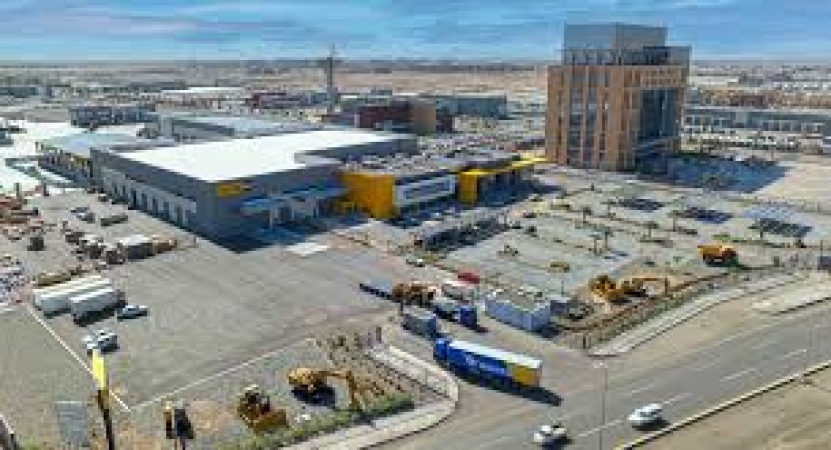
Barloworld is a JSE-listed industrial company and is the only distributor of Caterpillar construction equipment in Southern Africa.
The company has now been acquired by Newco, which comprises Gulf Falcon Holding, a subsidiary of Saudi Arabia’s Zahid Group, and Entsha, a company linked to Barloworld CEO Dominic Sewela.
In November 2025, Barlworld told shareholders that Newco’s R23 billion Standy Offer was closed, having been accepted by 97.6% of the Standy Offer Shares.
Newco announced that it intended to invoke section 123 of the Companies Act to acquire all of the Barloworld Ordinary Shares already held compulsorily for R120, which is known as a squeeze-out.
The squeeze-out was successful, and Newco’s compulsory acquisition of the remaining Barloworld Shares took place on 22 January 2026, having paid the necessary consideration for the shares.
The company has now announced that the Barlworld Ordinary Shares will be delisted from the JSE and A2X on Tuesday, 27 January.
Speaking on Moneyweb Radio, Sewela said the transaction took time largely because of the legal and governance scrutiny involved, particularly given that it was a leveraged buyout in which management played a leading role.
“The nature of a regulated transaction like this one does take a while because you’ve got various parties, and obviously, shareholders have a consideration,” he said.
“Shareholders have got to make sure there is no conflict of interest, and if there is, how it is managed, and from a value point of view, are we getting the right value.”
Sewela said these checks were necessary to ensure that shareholders were satisfied that the deal unlocked fair value.
While the length of the process may have appeared unusual, he stressed that it reflected the need to address those concerns properly.
Apart from the transaction mechanics, Sewela said a key driver behind the decision to delist was the strategic flexibility that comes with being a private company.
He noted that one of the most immediate benefits is the removal of the high costs associated with being listed.
More importantly, he added, delisting allows management to also spend more time focused on customers and operations rather than on the demands of public markets.
“If you’re listed, you spend a lot of time with analysts and asset managers, trying to explain the business and put numbers in their models. It can be very time-consuming and sometimes takes you away from what matters,” he said.
He also noted that Barloworld is now a smaller and more focused business than it was in the past, following unbundlings and the sale of non-core operations.
The group’s remaining core is cyclical in nature and requires close operational attention. “What’s core to us now is a business that’s cyclical, that requires attention to detail,” Sewela said.
Sewela said that this made it easier for him to support the team, given his experience in the business.
He also pointed to the tension between short-term market expectations and the long-term approach required to run a cyclical industrial business.
“The reason why Barloworld has been around now for going on 124 years is precisely the long-term view that the founders of this business had,” he said.
In public markets, diversification and long-term support through downturns can be penalised, even though such support is critical.
“When you have a cyclical business, you’ve got to be able to support it through a trough, and some of that support is supporting your own customers,” he said.
He added that being private allows the company to decide whether or not to pay dividends in a given year, rather than being “hard pressed” by shareholder expectations.
Sewela said the move away from public markets also allows management to focus on building intrinsic value rather than reacting to daily share price movements. (Business Tech)