ADAD
ADADUpdating your news feed...

NEWS EXPRESS is Nigeria’s leading online newspaper. Published by Africa’s international award-winning journalist, Mr. Isaac Umunna, NEWS EXPRESS is Nigeria’s first truly professional online daily newspaper. It is published from Lagos, Nigeria’s economic and media hub, and has a provision for occasional special print editions. Thanks to our vast network of sources and dedicated team of professional journalists and contributors spread across Nigeria and overseas, NEWS EXPRESS has become synonymous with newsbreaks and exclusive stories from around the world.






Loading banners
Loading banners...

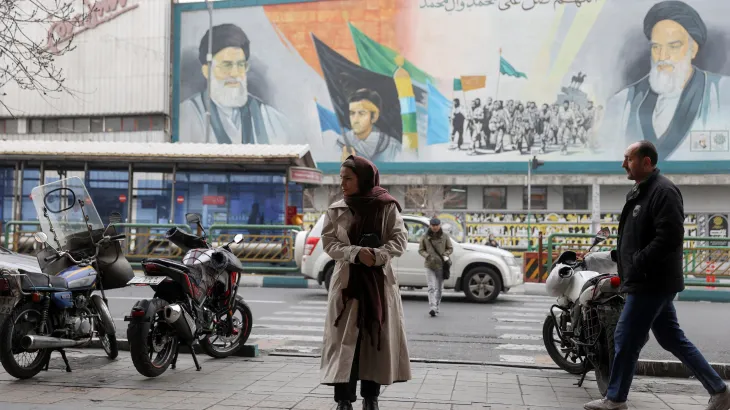
Iranian authorities have arrested four people on charges of attempting to “disrupt the country’s political and social order” and working “for the benefit” of Israel and the United States during the antigovernment protests last month.
The arrests were made on late Sunday and early Monday, and included prominent reformist politicians who have recently spoken critically about the theocratic establishment, according to Iranian media.
Those arrested were identified as Azar Mansouri, head of Iran’s Reformists Front, Mohsen Aminzadeh, a former diplomat, and Ebrahim Asgharzadeh, a former parliamentarian.
Hojjat Kermani, the attorney who represents the three arrested figures, told the semi-official ISNA news agency that Javad Emam, a spokesman of the Reformists Front, was also taken from his home by security forces.
Iran’s judiciary claimed that the group was behind “organising and leading extensive activities aimed at disrupting the political and social situation” at a time when the country faced “military threats” from Israel and the US, according to the official Mizan news agency.
The individuals had done their utmost “to justify the actions of the terrorist foot soldiers on the streets”, it said.
Iran’s Reformist Front confirmed the arrests in a statement on X.
It said Mansouri was arrested from the “door of her home under a judicial order” by the intelligence forces of Iran’s Revolutionary Guard Corps (IRGC).
It added that the IRGC has also issued summons to other senior members, including its deputy chairman, Mohsen Armin, and its secretary, Badralsadat Mofidi. Local media said another reformist figure, Feizollah Arab Sorkhi, was also summoned.
The arrests come amid anger in Iran over the deaths of thousands of Iranians during the January unrest. The protests began in the capital, Tehran, over a worsening economic crisis, but quickly escalated into a nationwide antigovernment movement.
Iranian authorities labelled the protesters as “terrorists” and blamed the “riots” on foreign interference from Israel and the US.
The government later said 3,117 people were killed during the unrest and rejected claims by the United Nations and international human rights organisations that state forces were behind the killings, most of which occurred on the nights of January 8 and 9.
The US-based Human Rights Activists News Agency (HRANA) said it has verified 6,961 deaths and is investigating 11,730 other cases. The organisation reports that at least 51,591 people have been arrested during and after the nationwide protests.
UN special rapporteur on Iran, Mai Sato, said over 20,000 people may have been killed during the protests as information remains limited amid heavy internet filtering by the state.
Reacting to the protest killings in a statement in late January, the Reformists Front had said it grieved “the great catastrophe” alongside the Iranian people, and called for major reforms and the formation of an independent fact-finding mission. It had also threatened to dissolve in case the “destructive methods of the past” persist.
Mir Hossein Mousavi, the former leader of reformists who has been under home arrest since the Green Movement of 2009, last month released his strongest statement to date, calling for a democratic transition away from the Islamic Republic and holding a constitutional referendum.
“How many ways must people say that they do not want this system and do not believe your lies? Enough. The game is over,” he wrote last month. At least four people, including a reformist figure and three activists, were arrested for helping draft and publish the statement.
Al Jazeera’s Tohid Asadi, reporting from Tehran, said the politicians arrested on Sunday and Monday face “serious allegations”.
He said Aminzadeh was a former deputy foreign minister during the presidency of Mohammad Khatami, who governed from 1997 to 2005, and that Asgharzadeh is a former lawmaker who was a student leader “involved in the takeover of the US embassy” in 1979.
“These figures have a background of political activism and imprisonment,” Asadi said. “So this is not the first time that they are facing such allegations. And they are going through a trajectory that could pave the way for imprisonment for them,” he said.
Analysts say the crackdown is a sign the Iranian government is trying to send a message to any other dissidents who challenge it.
“These are the people who have been calling for more political liberalisation. Some of them have called for the end of the Islamic Republic,” said Sina Azodi, the director of the Middle East Studies programme at George Washington University in Washington, DC.
“This tells me the Islamic Republic has decided to close any avenues for political dissent and, rather, to rule with an iron fist, through crackdowns and more fear-mongering among any political dissidents.”
The Iranian clampdown has also ratcheted up tensions with Washington.
When the protests first broke out, US President Donald Trump – who is seeking to curb Iran’s nuclear and missile programmes – threatened Tehran with new attacks if it used force against the protesters. Trump, who had ordered the US military strikes on three Iranian nuclear sites last June, also deployed a naval “armada” to the Gulf region.
The move prompted Iranian Supreme Leader Ayatollah Ali Khamenei to warn of a “regional war” if Iran is attacked, as well as a push by regional powers to ease the tensions.
The diplomacy resulted in Iran and the US holding indirect talks in Oman on Friday. President Masoud Pezeshkian described the discussions as “a step forward” in a social media post on Sunday and said his government favoured continued dialogue.
Another round of negotiations is scheduled for next week.
Phyllis Bennis, a fellow at the Institute for Policy Studies in Washington, DC, told Al Jazeera that she does not expect the latest arrests in Iran to affect the ongoing nuclear negotiations.
“I am not sure that these arrests are going to be a specific focus of the talks as they continue,” she told Al Jazeera. However, she noted the arrests come amid the talks in Oman and a planned visit by Israeli Prime Minister Benjamin Netanyahu to the US capital.
Netanyahu will probably demand Iran halt all uranium enrichment, end its missile programme, and stop supporting regional allies, Bennis said.
“It’s essentially a call for Iranian surrender,” she said.
“So there’ll be a big question as to whether the US is going to go along with the Israeli position or maintain its own position, which historically has been slightly different than Israel’s, particularly on the question of nuclear enrichment.” (Al Jazeera)