ADAD
ADAD
Updating your news feed...
NEWS EXPRESS is Nigeria’s leading online newspaper. Published by Africa’s international award-winning journalist, Mr. Isaac Umunna, NEWS EXPRESS is Nigeria’s first truly professional online daily newspaper. It is published from Lagos, Nigeria’s economic and media hub, and has a provision for occasional special print editions. Thanks to our vast network of sources and dedicated team of professional journalists and contributors spread across Nigeria and overseas, NEWS EXPRESS has become synonymous with newsbreaks and exclusive stories from around the world.





.webp)


.webp)


.webp)

Loading banners
Loading banners...

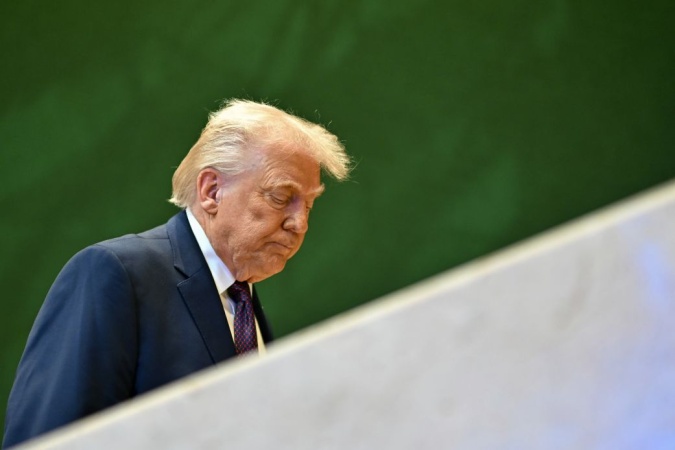
Even President Donald Trump’s push for total, unchecked power may struggle to overcome the potent combination of political reality and moral outrage.
Public fury over another horrific killing of a protester by federal agents in Minnesota on Monday prompted the White House to soften the tone of its federal immigration crackdown. It’s too early to say whether the blue state apparently chosen as a Petri dish for Trump’s strongman project will see changes to underlying deportation policies.
This course-correction on Trump’s signature domestic policy issue came less than a week after the failure of a brazen attempt to demonstrate his untamable authority abroad by wrestling Greenland away from Europe.
And it happened the day after Delcy Rodríguez, the leader of Venezuela’s rump regime after President Nicolás Maduro’s ouster, said she’d had “enough” of Trump’s imperialist bid to run her country from the Oval Office.
Another leader also just stood up to Trump. British Prime Minister Keir Starmer called his claim that NATO troops “stayed off the frontlines” during the Afghan War “frankly appalling.” The next day, Trump posted a social media tribute to 457 British war dead in a rare tacit admission of wrongdoing.
The first month of 2026 has unfolded in a bewildering rush of Trump’s attempts to impose his will — via a force of belligerent federal agents in Minneapolis, and by the threatened and actual punch of the US military abroad.
His power plays prompted widespread warnings that he was becoming an unchained autocrat; that he’d crushed remaining checks and balances on presidential power; and that the US democracy was being eroded.
“Sometimes you need a dictator” he said last week in Davos, Switzerland, days after suggesting to Reuters that “we shouldn’t even have an election” ahead of November’s midterms. After his aggressive first year back in office, such supposed jokes don’t seem that funny.
But the frenetic first weeks of the new year have also demonstrated that Trump will not have everything his own way. His domestic adversaries and foreign powers get a say — especially if they band together in coalitions.
This dynamic was conjured in a well received speech by Canadian Prime Minister Mark Carney in Davos, who argued that smaller countries needed to unite to protect their interests.
“The middle powers must act together, because if we’re not at the table, we’re on the menu,” Carney said.
In a social media video on Monday night, former transportation secretary and possible 2028 Democratic presidential contender Pete Buttigieg suggested that protests and pressure on Trump on immigration, healthcare, congressional redistricting and the Epstein files were creating an “accelerating change in the power dynamics of this country.”
“The ground is clearly shifting because all of us together have been doing the work of shifting it,” he said.
Growing criticism of Trump’s results suggests the normal counter-reactions set off when presidents splash their political capital still apply despite his sidelining of many of the conventions of traditional politics.
If a trickle of pushback becomes a torrent, then Trump will end up being far less feared.
On Monday, the White House belatedly seemed to realize that it has an optics problem in Minnesota.
► The president sent his border czar Tom Homan to the state in an implicit sign of lost confidence in two bombastic subordinates, Homeland Security Secretary Kristi Noem and top Border Patrol official Greg Bovino. Each official callously misrepresented the shooting deaths of Renee Good and Alex Pretti, despite contrary video evidence every American could see.
► Trump also spoke with Minnesota Gov. Tim Walz and Minneapolis Mayor Jacob Frey and claimed progress in ending a bitter showdown.
► A coalition of Minnesota business leaders — the kind of people to whom Trump often listens — called for a deescalation of tensions.
► Two court hearings related to the federal surge of agents into Minnesota on Monday, meanwhile, represented the latest example of Trump opponents using the legal system to slow his executive power grabs.
Trump’s change of tack is unlikely to have happened without a crescendo of public fury, resistance by local officials and growing concern among Republicans and some administration officials.
“We don’t want to see any Americans getting killed in the streets,” Republican Rep. Mike Lawler, who faces a tough reelection fight in New York, told CNN’s Kasie Hunt on Monday.
Sen. Ted Cruz warned on his podcast that the administration must do better on “tone” after incidents like Pretti’s killing. “They come out guns blazing … that we took out a violent terrorist,” the Texas Republican said.
And GOP Sen. Bill Cassidy of Louisiana on Saturday warned the credibility of ICE and DHS was at stake, writing on X, “We can trust the American people with the truth.”
Trump’s critics have long expressed rightful concern about his frequent attempts to stretch the limits of his office.
But the showdown in Minnesota also showed that the Constitution remains a vibrant playbook Americans can use to challenge his perceived abuses and to formulate effective positions of resistance.
► The First Amendment’s guarantee of the right to protest has been a frequent theme following the apparent denial of that protection by the agents who shoot Good and Pretti.
► The Trump administration is facing intense pushback from the firearms lobby, which objected to comments by FBI Director Kash Patel and other officials suggesting Pretti shouldn’t have taken a gun to a protest, ignoring the Second Amendment.
► And the Fourth Amendment is increasingly being invoked as a platform for legal challenges over unreasonable ICE searches of the homes of suspected undocumented migrants, which in some cases have wrongly targeted US citizens.
Footage of federal government officials descending on a state in masks while imposing the writ of a distant ruler also runs counter to a deep tradition of decentralized power embedded in America’s political psyche.
The behavior of administration officials also clearly backfired on Trump. But the idea that he’s been let down by loose-lipped officials would be misleading. Noem and Bovino often seemed to be appealing directly to the performative tastes of the man who appointed them. Trump’s second-term Cabinet was picked specifically to exclude the kind of moderating voices that tempered his wild instincts in his first term.
And Trump has set the tone for draconian immigration enforcement ever since jumping into politics in 2016. He personally maligned Good and Pretti after they were killed. On January 13, he lashed out on Truth Social at Minnesota Democrats, warning, “The day of reckoning and retribution is coming.”
Trump’s conduct may also have turned immigration — an issue key to his reelection — into a liability ahead of November’s midterm elections. Americans were deeply frustrated with the Biden administration’s failure to secure the southern US border. But the public doesn’t seem ready for military-style deportations of the majority of undocumented migrants who do not have criminal convictions.
Nobody died because of Trump’s attempt to grab Greenland last week, but his wildness could have serious geopolitical implications. Trust in the US among fellow NATO members — who’d had to confront the since withdrawn possibility of an American invasion of Greenland, took a serious blow.
But a president chasing a legacy was thwarted in his quest by rare and unified resistance from NATO allies who’d previously adopted a policy of genuflection. A panicked reaction by the stock market to his territorial ambitions and their implications also seemed to act as a restraint on Trump — not for the first time.
One immediate consequence is that once-friendly allies have started to look elsewhere for partnerships in a way that could backfire for the president. Canada, for instance, is considering an electric vehicles pact with US arch-foe China, which would be a great loss for the US auto industry.
The full context of Venezuelan leader Rodríguez’s comments about Trump is also yet to play out. But his claim that he’ll rule Venezuela as well as the United States is already being exposed to harsh reality.
US oil firms have already expressed skepticism about Trump’s plan to use them to revive Venezuela’s decrepit oil production facilities, given the astronomical costs involved. The US may seek to exert influence from beefed-up diplomatic and intelligence operations in Caracas, although attempts to dictate the paths of Latin American nations have a long and mixed history.
One thing Trump has in his favor is that constitutional and legal checks on US presidents are often retrospective. In his early months back in power, he was able to race ahead — as with his effort to gut US government agencies like USAID — before courts could delay him.
In many areas, Trump can flex the authority of the executive branch, and there’s not much that opponents can do. But elsewhere, he could encounter real resistance — for instance, in a forthcoming Supreme Court ruling on the legality of his tariff policies.
The ambitions of a president who tried to steal an election in 2020 to stay in power should never be underestimated. Dangerous disruption and societal conflict almost certainly lie ahead.
But a turbulent first month of 2026 shows that the narrative of Trump as an untouchable strongman leader impervious to all restraint is not yet baked in. (CNN)