Updating your news feed...
NEWS EXPRESS is Nigeria’s leading online newspaper. Published by Africa’s international award-winning journalist, Mr. Isaac Umunna, NEWS EXPRESS is Nigeria’s first truly professional online daily newspaper. It is published from Lagos, Nigeria’s economic and media hub, and has a provision for occasional special print editions. Thanks to our vast network of sources and dedicated team of professional journalists and contributors spread across Nigeria and overseas, NEWS EXPRESS has become synonymous with newsbreaks and exclusive stories from around the world.

























Loading banners
Loading banners...

Nigerian crypto transaction chart
For years, cryptocurrency served as a financial escape hatch for millions of Nigerians, an alternative to currency controls, inflation and a shallow tax net. From 2026, that era will formally end.
Under the Nigerian Tax Administration Act (NTAA) 2025, the Federal Government has created a framework that pulls cryptocurrency transactions into the country’s formal tax system. All digital asset activity must now be linked to Tax Identification Numbers (TINs) and National Identification Numbers (NINs), while Virtual Asset Service Providers (VASPs), including exchanges and brokers, will be responsible for enforcing compliance, reporting transaction data and flagging suspicious activity.
The shift marks one of Nigeria’s most consequential fiscal policy moves in the digital economy, transforming crypto from a largely informal store of value into a measurable, taxable component of national revenue.
From informal wealth to formal revenue
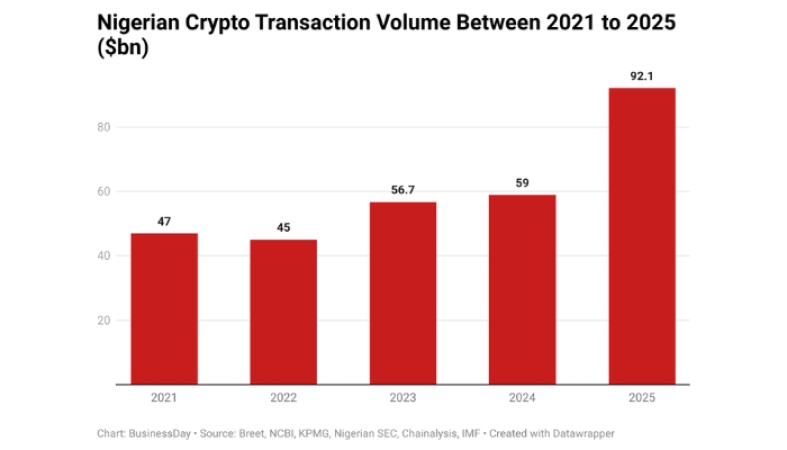
Nigeria is among the world’s fastest-growing crypto markets, with an estimated $92.1 billion in transaction volume between July 2024 and June 2025. Yet, most of that activity has existed outside the tax system, mirroring a broader fiscal challenge: Nigeria collects less than 10 percent of GDP in taxes, one of the lowest ratios globally.
By bringing crypto into the tax net, authorities are targeting a rapidly expanding pool of digital wealth as they pursue an ambitious goal of raising the tax-to-GDP ratio to 18 percent by 2027 and reducing dependence on oil revenues.
Rather than attempting to monitor blockchains directly, the government is placing the compliance burden on intermediaries. VASPs must register with tax authorities, conduct strict know-your-customer checks, submit regular transaction reports, retain records for at least seven years, and report large or unusual transactions to the Nigerian Financial Intelligence Unit (NFIU). Penalties for non-compliance include fines of up to N10 million and potential licence suspension or revocation.
The approach aligns Nigeria with international standards such as the OECD’s Crypto-Asset Reporting Framework, effectively inserting the country into the global crypto compliance system.
End of anonymity, beginning of accountability
For users, the policy redraws the social contract that made crypto attractive in the first place. Digital assets in Nigeria have long been prized for speed, access and a perception. Under the new rules, that anonymity largely disappears on centralised platforms.
Crypto educator and platform founder C4B Freedom has warned users that exchanges servicing Nigerians will be compelled to demand TIN or NIN verification before allowing transactions, advising those without documentation to consider moving funds into self-custody.
“Some people won’t have access to their funds if they can’t provide the necessary documents,” he said, adding that while taxation is inevitable, the transition could be disruptive.
Industry voices expect a short-term migration toward decentralised exchanges and non-custodial wallets, potentially shrinking the visible tax base before it stabilises. Retail traders, in particular, worry that compliance requirements could arrive abruptly, leaving unprepared users exposed.
Exchanges welcome legitimacy, warn of leakage
For exchanges, the framework promises long-term legitimacy but introduces near-term operational risks. Ayotunde Alabi, chief executive of Luno Nigeria, said the sequencing of policy remains a concern.
“This tax framework is a step toward legitimacy, but taxation moving faster than proper licensing creates uncertainty. Who exactly is in scope when most operators lack full VASP licences?” he asked.
He warned that uneven enforcement could undermine the policy’s objectives by pushing users toward informal peer-to-peer channels, defeating the goal of transparency and revenue collection.
Others see the disruption as part of a broader maturation process. JB of Lagos, co-founder of Tradepal.ai and convener of the Onchain Festival, described the framework as unavoidable for a market of Nigeria’s size.
“All transactions tied to TIN and NIN, strict KYC, monthly reporting, seven-year records, this formalises the market and could boost credibility long-term. But the immediate compliance burden on users and exchanges is heavy,” he said, predicting short-term behavioural shifts toward decentralised alternatives.
Crypto and forex trader EmmyBlaq echoed that view, describing the government’s intent as unmistakable. “Crypto is no longer ‘anonymous’ in Nigeria. Your account must link to TIN and NIN. With $92 billion in volume, they want that revenue contributing to an 18 percent tax-to-GDP target,” he said, adding that traders would need to adapt quickly.
Privacy traded for institutional trust
Developers say the law underscores how swiftly Nigeria has moved from restriction to oversight. Idris, a Web3 developer and DevRel specialist, described the transition as a double-edged sword.
“From banned to tracked in record time. Your wallet to TIN and NIN to government tax cut. Welcome to formalisation,” he said.
While the framework could attract institutional capital and improve credibility, it undermines one of crypto’s original appeals: privacy. He predicts renewed innovation around decentralised and privacy-preserving tools.
Regulatory gridlock ahead of 2026
As ambitious as the tax framework is, its success hinges on execution and here analysts see risk. Nigeria’s crypto market faces uncertainty as stalled licensing, rising compliance costs and the impending tax regime threaten to push users deeper into unregulated P2P channels.
The NTAA mandates registration with the Federal Inland Revenue Service (FIRS), strict KYC, seven-year data retention and compulsory reporting of suspicious or high-value transactions to FIRS and the NFIU. Violations attract penalties of N10 million in the first month and N1 million for each additional month, alongside the risk of licence suspension or revocation by the Securities and Exchange Commission (SEC).
Yet only two exchanges, uidax and Busha, have been approved under the SEC’s Accelerated Regulatory Incubation Programme, more than a year after receiving Approval-in-Principle. No additional licences have been issued since August 2024, despite several applications in the queue.
Operators argue that taxing a sector where most players remain unlicensed risks backfiring. SEC officials have cited the need for deeper due diligence, but industry leaders say the prolonged wait is stifling growth and discouraging retail participation.
The NTAA classifies trades, transfers, mining income, staking rewards, airdrops and crypto payments for goods and services as taxable, mirroring practices in more advanced markets. But critics say Nigeria lacks the regulatory infrastructure to implement the law effectively.
Obinna Iwuno, the CEO of CBC Blockchain Services, argues that taxation arriving ahead of broad licensing empowers underground markets. “You don’t strengthen regulation by shrinking the formal market,” he said, urging regulators to expand licensing, introduce tiered regimes and prioritise data protection.
Iwuno also cautions against inflated revenue expectations. With most Nigerians trading on foreign exchanges beyond local regulatory reach, capturing meaningful tax revenue will be difficult without a comprehensive licensing and enforcement strategy.
Crypto’s new place in Nigeria’s economy
By relying on exchanges rather than direct blockchain surveillance, Nigeria is aligning with global norms. More fundamentally, the policy redefines crypto’s role, from a parallel financial system to a recognised contributor to public revenue.
Whether it delivers sustained fiscal gains or simply reshapes user behaviour toward decentralised alternatives will become clearer after 2026. What is already certain is that crypto in Nigeria is no longer just an escape hatch. It is becoming part of the state’s fiscal architecture.
In turning crypto into a tax base, Nigeria is making a broader statement. In a country searching for revenue beyond oil, even the most decentralised forms of money are no longer beyond reach. (BusinessDay)