ADAD
ADAD
Updating your news feed...
NEWS EXPRESS is Nigeria’s leading online newspaper. Published by Africa’s international award-winning journalist, Mr. Isaac Umunna, NEWS EXPRESS is Nigeria’s first truly professional online daily newspaper. It is published from Lagos, Nigeria’s economic and media hub, and has a provision for occasional special print editions. Thanks to our vast network of sources and dedicated team of professional journalists and contributors spread across Nigeria and overseas, NEWS EXPRESS has become synonymous with newsbreaks and exclusive stories from around the world.


Loading banners
Loading banners...

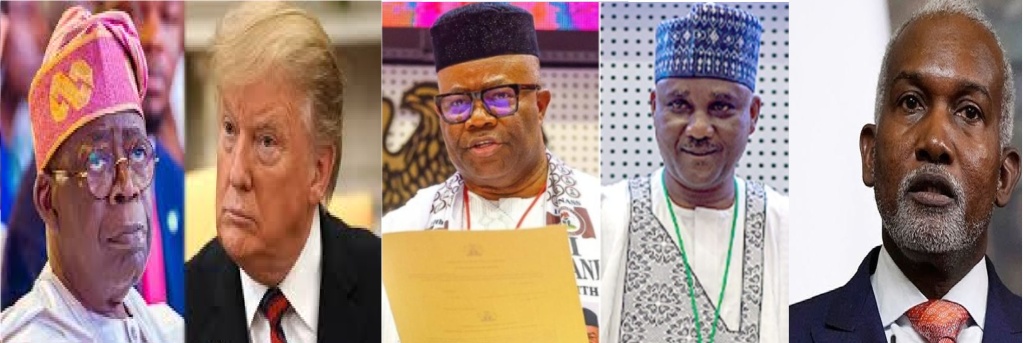
Collage of Tinubu, Trump, Akpabio, Ribadu, Tuggar and Abbas
A $9 million U.S. lobbying deal meant to manage Nigeria’s image has instead deepened scrutiny of the Tinubu administration, as critics argue it reflects diplomatic paralysis, economic misjudgment and desperation amid worsening insecurity and foreign pressure.
They noted that the country is paying to explain itself abroad because it failed to govern, communicate, and represent itself effectively at home and through its diplomatic institutions.
Nigeria’s failure to appoint ambassadors for more than a year left the country increasingly dependent on expensive foreign lobbyists to defend its interests abroad, culminating in the contract worth an estimated N13 billion with a United States firm closely linked to President Donald Trump.
Documents filed under the U.S. Foreign Agents Registration Act (FARA) and seen by The Guardian show that the Nigerian government retained DCI Group, a Washington-based lobbying and public relations firm, to counter growing pressure from the U.S. over allegations of targeted killings of Christians in Nigeria.
Foreign policy analysts, however, say the engagement highlights the cost of a prolonged diplomatic vacuum left by President Bola Tinubu’s September 2023 recall of all Nigerian ambassadors, which has yet to be filled as of early 2026.
The recall, announced by the Ministry of Foreign Affairs, left Nigeria without substantive diplomatic representation in key capitals, including Washington, at a time of heightened international scrutiny.
In April 2024, President Tinubu appointed 14 consuls-general for 14 countries but did not appoint functional ambassadors.
“But in the strict hierarchical order of the world of diplomacy, seniority in rank or position counts a lot, and this is where Nigeria may be missing out,” Ambassador Ogbole Amedu-Ode, former spokesman of the Ministry of Foreign Affairs, said recently in a media report.
“Diplomacy is not something you outsource permanently,” a former Nigerian ambassador to the U.S. told The Guardian. “When you have no ambassadors, no political counsellors with authority, lobbying firms fill the gap, and they charge a premium.”
The FARA filing shows that DCI Group was hired through Aster Legal, a Kaduna-based law firm, acting on behalf of Nuhu Ribadu, the national security adviser. The contract, dated December 17, 2025, authorises the firm to “assist the Nigerian government… in communicating its actions to protect Nigeria’s Christian communities and in maintaining US support for counter-terrorism efforts against West African jihadist groups and other destabilising elements.”
Under the agreement, Nigeria is to pay $750,000 monthly, amounting to $4.5m for an initial six-month term, with an automatic renewal that could bring the total value to $9m. Payment records attached to the filing show that $4.5m was paid on 12 December as an upfront retainer.
The contract allows either party to terminate the deal with 60 days’ written notice, without penalty.
ADC faults lobbying contract, accuses Tinubu govt of misplaced priorities
The African Democratic Congress (ADC) condemned the administration of President Bola Ahmed Tinubu over the contract for lobbying services in the United States, describing the move as an attempt to launder its image abroad amid worsening insecurity and economic hardship at home.
In a statement issued by its National Publicity Secretary, Bolaji Abdullahi, the party said the expenditure reflected misplaced priorities at a time when many Nigerians were struggling to afford necessities, and thousands had been killed by insecurity.
According to the party, the decision to fund foreign lobbying while citizens faced rising hardship showed moral blindness and could not conceal what it described as the government’s failure to protect lives and property.
The party said the move amounted to an admission of diplomatic failure, arguing that the government had left key ambassadorial positions vacant and was now seeking to outsource diplomacy to lobbyists, a development it said weakened Nigeria’s institutional credibility.
The ADC also rejected the notion that paid lobbying could offset what it described as mass killings and widespread insecurity in the country, insisting that no public relations effort abroad could substitute for a coherent strategy to address security challenges at home.
It further warned against framing the lobbying effort as a campaign to communicate “Christian protection efforts”, saying such an approach risked deepening sectarian tensions and politicising security in a country already strained by religious and ethnic divisions.
The party said security challenges affect all Nigerians regardless of faith and should be addressed through justice, accountability, and effective governance, rather than through selective messaging overseas.
The ADC maintained that Nigeria did not need propaganda but leadership, adding that public resources should be directed towards protecting lives, restoring confidence in state institutions, and rebuilding the country, rather than polishing the image of a government it accused of failing in its most basic responsibility.
PDP queries lobbying contract, calls it deceptive, embarrassing
The Peoples Democratic Party (PDP) criticised the reported public relations and lobbying contract between the Federal Government and the United States-based firm, DCI Group, describing the arrangement as defective, deceptive and embarrassing.
In a statement issued yesterday, the party’s National Publicity Secretary, Ini Ememobong, said the contract, reportedly facilitated through Aster Legal, was intended to assist the Nigerian government in communicating its actions to protect Christian communities and was structured to run for six months with an automatic renewal for another six months.
Ememobong expressed concern that an administration with a fully fledged Ministry of Information and multiple media aides would resort to hiring a foreign firm to manage its image abroad.
According to him, the move suggested a lack of confidence in the Ministry of Information and the government’s media apparatus, despite being headed by what he described as seasoned professionals.
“The revelation is as disturbing as it is shameful,” he said, adding that the ministry, under a public relations expert, had in recent years demonstrated “maturity and responsibility” in handling government communication.
The PDP demanded clarification from the Presidency on whether the contract was provided for in the 2025 budget, why it was executed through a private law firm rather than the Federal Ministry of Justice, the roles of information and public relations officers in Nigeria’s diplomatic missions, and the performance benchmarks for the deal.
Ememobong argued that no lobbying firm could replace the lived realities of Nigerians, particularly in an age of instantaneous global information flow.
He said that if the administration of President Bola Tinubu was serious about improving Nigeria’s image abroad, it should prioritise the security of lives and property rather than what he termed “deceptive communication”.
“The undeniable truth is that Nigerians have not felt this insecure, even during the civil war,” he said, urging the President to guarantee the safety of all citizens regardless of religion and to reduce incidents of mass killings.
The party said genuine improvements in security would naturally reshape global perceptions of Nigeria, calling on the President to focus on lasting solutions to insecurity rather than what it described as fleeting public validation.
Tinubu’s lobbying act of desperation, lack of confidence, analysts say
Reacting to the development, the President of the Association of Foreign Relations Professionals (AFRP), Ambassador Gani Lawal, described the lobbying deal as a consequence of the prolonged neglect of Nigeria’s diplomatic machinery.
“That is the price to pay for being pennywise and pound foolish. Ambassadors are supposed to be the eyes, the nose and the legs of the country wherever they are posted. But allowing our missions to remain without ambassadors for such a long time gave room for these lapses, which some people have now taken advantage of,” Lawal said while speaking with The Guardian.
He argued that if Nigeria had properly told its own story through established diplomatic channels, there would have been little need to spend millions of dollars on foreign lobbyists.
“If we had been able to tell our stories ourselves, it would have been different, because we would be speaking from a position of facts and figures, not speculative judgments,” he said.
Lawal maintained that the appointment of ambassadors should not be reduced to a cost-saving measure, stressing that diplomacy goes far beyond financial considerations.
According to him, Nigeria’s absence from key diplomatic spaces has weakened its ability to counter negative narratives abroad, particularly allegations of targeted violence against Christians, which the Federal Government has consistently rejected.
Lawal urged the government to urgently deploy credible and experienced diplomats to strategic global capitals, even if not to all countries at once.
“This is not the time to choose ambassadors on the basis of politics. It is a very critical time. We need people of proven records, people well known in the diplomatic world, at least for the first one or two years, to stabilise the ship of our foreign policy,” he said.
On whether the $9 million expenditure could be justified, Lawal adopted a more nuanced stance, describing the lobbying contract as a temporary emergency response rather than a long-term solution.
“No amount of money is too much to be spent now, given what we are going through, but it should be a one-time, stopgap measure. It cannot be an ongoing thing. What we are doing now is a fire-brigade approach to correct a problem we created for ourselves,” he said.
Tietie: Lobbying driven by desperation, lack of confidence
Describing the move as the height of desperation, a lawyer and public affairs analyst, Frank Tietie, said the All Progressives Congress had taken a similar step in the past when it appointed a public relations company to help the late Muhammadu Buhari defeat former President Goodluck Jonathan.
He said the difference in the two situations was that, in this instance, the government allegedly hired a PR firm to influence the policy direction of a foreign country.
“There is a very strong belief that the government did this. Because it is in a state of desperation, it has opened itself to taking desperate measures, including the use of lobbyists. In this case, the appointment of a conservative lobbyist is aimed at changing the mindset of Donald Trump.”
Tietie said that although it is legitimate to deploy powerful and influential tools, such as PR firms, to shape public opinion and influence public policy, Nigeria’s decision was driven by desperation and a lack of confidence in the heads of its foreign missions.
According to him, even where the government had appointed ambassadors, they generally lacked the capacity to carry out lobbying, particularly political lobbying of the magnitude required to influence a country’s policy direction.
“They may be able to make representations and drive the foreign policy agenda of their home country. However, they do not possess the persuasive public relations skills to change public opinion in their host countries.
“Not only public opinion, but also policy direction. That is why it becomes a serious necessity. The decision to hire PR experts also exposes the lack of confidence the government has in itself and in its officials to effectively drive home its position.
“The Nigerian government is operating on America’s position on alleged Christian genocide in Nigeria from a position of inferiority. This is because it has a poor record on corruption, security management, and its inability to adequately explain its failure to protect certain categories of persons.
“So, it is like a schoolboy approaching a headmaster to negotiate against an opinion the headmaster already holds of him.
“The Nigerian government is operating from a very weak standpoint. Therefore, it needs to bolster its messaging on this matter through professional and reputable PR machinery, in this case a lobbying firm,” Tietie said.
He added that Nigeria had deployed some of its highest-ranking officials to the United States on the issue, but the effort yielded no result.
“The government has seen that this did not change the position in any way. So, it decided not to operate from Nigeria anymore, but from within the U.S. by engaging this firm,” he said.
Deal shows lack of readiness for governance, says analyst
Also, a public affairs analyst and former Director of the Peoples Democratic Party (PDP) Presidential Campaign, Oladimeji Fabiyi, described the lobbying contract as evidence of the current administration’s poor preparation for governance.
“When you have a leadership that is not prepared for governance, this is what happens,” Fabiyi said. “We experienced something similar when ministers were not appointed for months. Now, ambassadors have not been appointed, and this is the result.”
Fabiyi argued that ambassadors are meant to serve as the country’s first line of defence in shaping international perception.
“Ambassadors are the buffer for the country. If they were in place, we would not have reached this level of hiring lobbyists. This is the third year of this government, and we are still dealing with this vacuum,” he said.
He criticised the decision to spend millions of dollars on lobbying at a time when the country is facing deficits in education, infrastructure, and social services.
“Five million dollars, ten million dollars — these are huge sums in a country where people cannot afford basic needs. Yet, the government says there is no money, but there is money for lobbying,” Fabiyi said.
According to him, the situation portrays Nigeria as reactive rather than proactive in its foreign policy, forcing the country to buy credibility instead of earning it through consistent engagement.
The Federal Government has previously accused foreign lobbyists and interest groups of fuelling the “Christian genocide” narrative in the United States and shaping negative international perceptions of Nigeria’s security challenges.
However, critics argue that such narratives thrive in the absence of strong and visible diplomatic engagement.
Meanwhile, pressure continues to mount on the administration to explain the expenditure, deploy the long-awaited ambassadors, and articulate a clearer strategy for managing Nigeria’s image and interests abroad.
For many observers, the $9 million lobbying deal has become more than a financial controversy; it has evolved into a broader debate about Nigeria’s foreign policy priorities, diplomatic readiness, and the cost of delayed decision-making in an increasingly complex global environment.
HURIWA faults lobbying contract, calls it wasteful, deceptive
The Human Rights Writers Association of Nigeria (HURIWA) criticized the Federal Government over the reported $9 million contract awarded for lobbying services in the United States, describing the move as wasteful, hypocritical and a smokescreen.
In a statement, the group said the decision to engage a US-based lobbying firm to communicate Nigeria’s efforts at protecting Christians amounted to a misuse of scarce public resources at a time of widespread insecurity and economic hardship.
HURIWA argued that the funds could have been better deployed to support soldiers battling terrorism, adding that developments in Nigeria’s security landscape were already well documented by international media with correspondents on the ground.
The group also questioned the rationale for spending millions of dollars to brief the US government, which maintains diplomatic representation in Nigeria and had recently sent a congressional delegation to assess security conditions across affected states.
Its National Coordinator, Emmanuel Onwubiko, said the contract was contradictory, noting that while the government had publicly denied claims of targeted attacks on Christians, it was simultaneously seeking foreign lobbyists to explain protection efforts.
HURIWA urged the government to prioritise transparency, effective diplomacy and the deployment of ambassadors rather than what it described as expensive propaganda abroad.
Trump-linked firm
DCI Group’s political connections are well-documented. Jim Murphy, a former president of the firm, served as national political director of Trump’s 2016 presidential campaign and managed floor operations at three Republican National Conventions, according to reports by The New York Times.
Another senior executive, Justin Peterson, the firm’s managing partner and a signatory to the Nigeria contract, was appointed by Trump in 2020 as the US president’s representative to the Financial Oversight and Management Board for Puerto Rico, a position he held until 2023. His biography on DCI Group’s website confirms earlier roles as a congressional aide and Republican campaign operative.
Analysts say these links are central to the firm’s value proposition at a time when Nigeria faces an openly hostile White House.
The lobbying effort comes amid escalating US criticism of Nigeria over violence affecting Christian communities.
In October, President Trump redesignated Nigeria as a “country of particular concern”, citing allegations by US lawmakers and advocacy groups of systematic persecution of Christians.
Nigeria has repeatedly rejected the claim of a Christian genocide, arguing that insecurity in the country affects all communities and is driven by jihadist insurgency, banditry and communal conflicts.
However, without an ambassador in Washington to engage lawmakers, the State Department and the White House directly, Nigeria has decided to rely on external intermediaries, which come at a high cost.
U.S. suspends immigrant visa processing for Nigeria, Ghana, 73 other countries
The United States has announced the suspension of immigrant visa processing for citizens of 75 countries, marking the latest move by President Donald Trump to restrict entry for foreigners seeking permanent residence.
A spokesperson for the US State Department said yesterday, that immigrant visa processing for the affected countries had been paused, adding that the decision would take effect from January 21 and remain in force until further notice.
According to an internal memo seen by Fox News Digital, consular officers have been instructed to refuse immigrant visas under existing legal provisions while the department reviews its screening and vetting procedures.
The State Department said the suspension was part of efforts to reassess immigration processes and prevent the entry of foreign nationals who may become dependent on public welfare. While US authorities have long denied visas to applicants considered likely to rely on government assistance, officials said the same authority would now be applied more broadly, based on nationality.
State Department spokesman Tommy Pigott said the Trump administration was determined to end what it described as abuses of the US immigration system, stressing that the pause would allow for a comprehensive review of procedures.
White House Press Secretary Karoline Leavitt said the affected countries would include Somalia, Russia and Iran, while a Fox News report also listed countries with friendly ties to the US, such as Brazil, Egypt and Thailand.
The State Department disclosed that more than 100,000 visas had been revoked since Trump’s return to office, a record figure for one year. Meanwhile, the Department of Homeland Security said last month that over 605,000 people had been deported, with about 2.5 million others leaving voluntarily.
The suspension does not apply to tourist, business or other non-immigrant visas, although the administration has said all applicants will be subjected to enhanced vetting, including reviews of social media activity.
Police confirm awareness of U.S. airstrikes in Sokoto, decline details
The Nigeria Police Force has said it is aware of the recent United States airstrikes against terrorist targets in Sokoto State but declined to disclose details of the operation.
The Force Public Relations Officer, Benjamin Hundeyin, stated this on Tuesday while speaking on Politics Today, a political programme on Channels Television.
Hundeyin said the police were actively involved in intelligence gathering and cooperation with other security agencies, but would not comment publicly on the airstrikes.
“We engage a lot in intelligence gathering, not just intelligence sharing. As the Police Force, we know certain things about the strikes, but we don’t want to talk about them. We decline to talk about that particular operation,” he said.
He added that while there was cooperation among security agencies, the matter fell within the responsibility of defence authorities.
“There was cooperation, but we would rather leave it as a defence matter that the defence would talk about,” Hundeyin said. (The Guardian)