Updating your news feed...
NEWS EXPRESS is Nigeria’s leading online newspaper. Published by Africa’s international award-winning journalist, Mr. Isaac Umunna, NEWS EXPRESS is Nigeria’s first truly professional online daily newspaper. It is published from Lagos, Nigeria’s economic and media hub, and has a provision for occasional special print editions. Thanks to our vast network of sources and dedicated team of professional journalists and contributors spread across Nigeria and overseas, NEWS EXPRESS has become synonymous with newsbreaks and exclusive stories from around the world.














Loading banners
Loading banners...

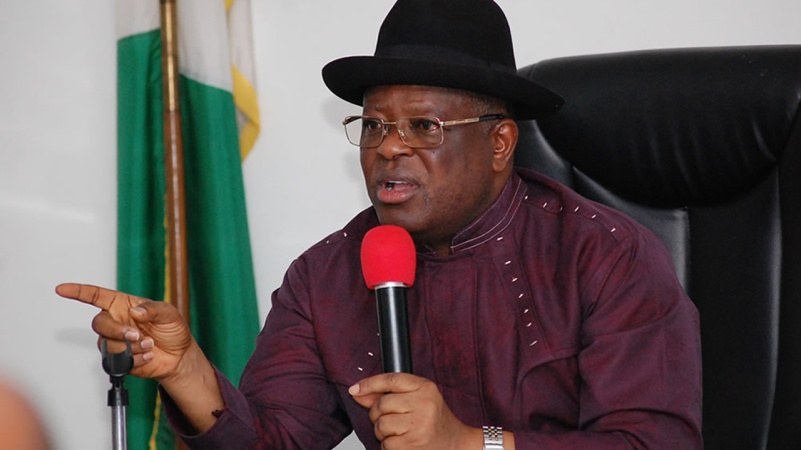
Works Minister, Sen Umahi
By ONIBIYO EZEKIEL PhD, ACA
The recent inauguration of the N40 billion Close Circuit Television (CCTV) surveillance centre for the Third Mainland Bridge by the Honourable Minister of Works, Senator Dave Umahi, is a watershed moment in Nigeria’s infrastructure governance. This move, alongside the minister’s visible and commendable drive to rehabilitate our crumbling road networks, demonstrates a forward-thinking approach that transcends mere concrete and steel. It speaks to a deeper understanding of infrastructure as a living, dynamic asset that requires continuous protection to deliver its socio-economic dividends.
The Minister has achieved a watershed moment in infrastructure delivery, moving beyond the simple commissioning of a critical asset to deeply fortify it with an embedded Minimum Security Standard (MSS). This proactive measure to secure the nation’s future investment is a rare accomplishment locally, showcasing a leader who transcends the ordinary. More than a politician or an engineer, he is a custodian of public trust deeply conscious of his duty to protect the enormous funds placed under his stewardship. This is the mark of true accountability
However, the true potential of this world-class facility will only be realized if its operational framework is seamlessly aligned with Nigeria’s overarching national security architecture for Critical National Assets and Infrastructure (CNAI). The minister’s hint at involving other security agencies beyond the police is astute. It opens the door for a conversation that is both urgent and rooted in existing national policy and law.
Globally, the protection of critical infrastructure has evolved from manned guards and perimeter fencing to integrated, technology-driven command-and-control ecosystems. The United States’ Department of Homeland Security, the United Kingdom’s Centre for the Protection of National Infrastructure (CPNI), and similar bodies operate on a principle of “layered defence.” This involves real-time monitoring, coordinated intelligence sharing, and rapid response by specialized units, all underpinned by a clear legal mandate.
Senator Umahi’s CCTV centre is, in essence, Nigeria’s own version of a sophisticated monitoring node. Yet, a node requires a network. Its feeds are data, and data requires a specialized, legally-mandated force to interpret it into actionable intelligence and deployable force against infrastructure-specific threats like sabotage, vandalism, and the insidious scourge of illegal dredging that erodes bridge foundations.
The National Policy Compass: The 2024 CNAI-NPPS
This is where the recently signed 2024 Critical National Assets and Infrastructure National Protection Policy and Strategy (2024 CNAI-NPPS) becomes the indispensable guide. This presidential policy is not a mere document; it is Nigeria’s strategic doctrine for harmonizing all efforts to safeguard the arteries of our economy and national life. The policy unequivocally calls for clear lines of responsibility, inter-agency collaboration, and the leveraging of technology. The Third Mainland Bridge CCTV centre is a perfect test case for its implementation. To hand over its operations solely to a general law enforcement agency would be to underutilize both the technology and the policy. The strategy demands a more nuanced, mandate-specific approach.
This brings us to the often-overlooked but crucial statutory anchor; the Nigeria Security and Civil Defence Corps (NSCDC) Act of 2004. This Act, in no ambiguous terms, establishes the NSCDC as the lead agency with the primary mandate to “protect and safeguard all Critical National Assets and Infrastructure.” This is not a shared or ancillary function; it is the Corps’ raison d'être.
The police are mandated for general public safety and order a vital role. But the NSCDC is the specialist, the dedicated guardian trained specifically in anti-vandalism, infrastructure threat assessment, and the protection of public utilities. Ignoring this clear statutory demarcation creates operational ambiguity, dilutes accountability, and fragments the very “total security architecture” the new CCTV centre aims to create.
Therefore, to commend Senator Umahi’s excellent work is also to urge its logical culmination. The donation of speed boats to the NSCDC in Lagos was not just a masterstroke but an hat trick by His Excellency David Umahi, providing the aquatic response capability. Now, integrating the CCTV command centre into the NSCDC’s operational grid is the next strategic step. Here is what this will create
1. A Mandate-Aligned Command Chain:* CCTV alerts on suspicious activity near bridge pillars or unauthorized maritime approaches trigger a direct response from the agency whose core KPI is infrastructure protection. This reduces response latency and increases effectiveness.
2. A Hierarchical Monitoring Network:* The CCTV feed should be cascaded in real-time not just to a standalone centre, but to the NSCDC Divisional Office at the bridge location (for immediate response), the Lagos State Command (for tactical oversight), and National Headquarters (for strategic situational awareness). This creates a unified, tiered command structure.
3. The Anti-Dredging Digital Shield:* The centre’s underwater camera capability is revolutionary for combating illegal dredging. The NSCDC, with its marine units and speed boats, can act on this intelligence instantly, moving from digital detection to physical interdiction, thereby protecting the bridge’s structural integrity from its most hidden threat. The writer is aware that there is a Directorate on Critical National Assets and Infrastructure Protection in the office of National Security Adviser (ONSA) which jointly with NSCDC, Ministry of Works, and National Inland Waterways (NIWA) outlawed dredging 1500metre to bridges.
4. Fulfillment of the 2024 CNAI-NPPS Vision:* This model becomes a replicable template for all critical infrastructure nationwidepower installations, dams, pipelines, and communication hubs. It transforms the policy from paper into practice. Most infrastructure in Nigeria lacks Minimum Security Standard (MSS) and that is a clear cut departure from security-by-design and this is the real essence that the Honourable Minister of Works and Transportation has woken up and should be replicated in other infrastructure delivery in Nigeria.
Senator Dave Umahi has shown exemplary vision in delivering this infrastructure. The final piece of the puzzle is to ensure its protection architecture is as robust and visionary as its engineering. By formally integrating the Third Mainland Bridge CCTV centre with the Nigeria Security and Civil Defence Corps, guided by the 2024 CNAI-NPPS and anchored in the NSCDC Act, the minister will achieve something profound.
He will move beyond installing security infrastructure to institutionalizing a national protection ecosystem. This would be a legacy-defining achievement: creating a sustainable, legally-sound, and globally-resonant model where brilliant engineering is secured by brilliant, doctrine-driven protection. It is the logical and necessary step to secure not just a bridge, but the future of Nigeria’s critical infrastructure
•Dr. Ezekiel Rotimi Onibiyo is a Research fellow with Al Mustapha Peace and Unity Development Institute, Abuja and can be reached at temiowa@yahoo.com