Updating your news feed...
NEWS EXPRESS is Nigeria’s leading online newspaper. Published by Africa’s international award-winning journalist, Mr. Isaac Umunna, NEWS EXPRESS is Nigeria’s first truly professional online daily newspaper. It is published from Lagos, Nigeria’s economic and media hub, and has a provision for occasional special print editions. Thanks to our vast network of sources and dedicated team of professional journalists and contributors spread across Nigeria and overseas, NEWS EXPRESS has become synonymous with newsbreaks and exclusive stories from around the world.






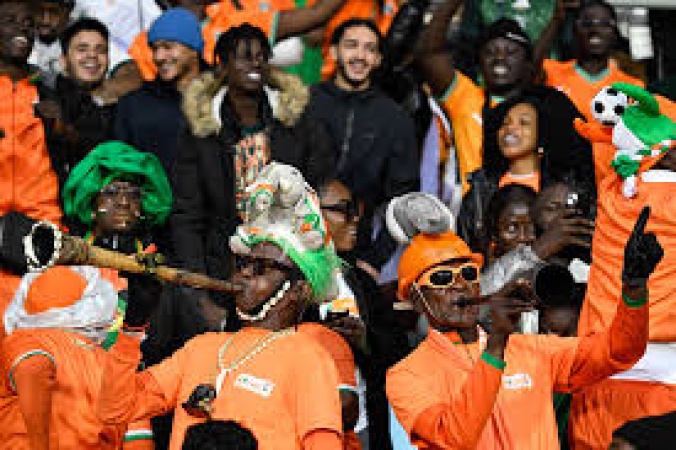
AFCON fans
By Fr. OKHUELEIGBE OSEMHANTIE AMOS
Greatness knows no single path. Some meet it by chance, some by luck, some are elected for it, some are chosen for it, some work for it, and others inherit it. This evening, we trace the story of a man who met greatness simply by standing through.
Many went to Morocco for AFCON to watch football. While players chased goals and glory, one fan’s silent presence captured hearts, stirred conversations across continents, and transformed a football stadium into a theatre of memory, meaning, and identity. Michel Kuka Mboladinga, better known among supporters as “Lumumba Vea,” became the most compelling figure of the tournament — a fan whose tribute spoke more powerfully than any goal scored.
Michel Kuka Mboladinga, a 53-year-old Congolese supporter, did something extraordinary at AFCON: he stood perfectly motionless throughout DR Congo’s matches, dressed sharply in vibrant attire, his right arm raised with an open palm toward the sky, fixed in the iconic pose of a statue of Patrice Lumumba, the Democratic Republic of Congo’s first prime minister and a towering symbol of African independence.
What made this act astonishing was not just its stamina — holding the position for the full duration of every match, including 120 minutes against Algeria — but its intent. Kuka explained that his stillness was meant “to give strength to the team, to pass energy to the players,” transforming a simple gesture into a ritual of support and power that transcends ordinary fandom.
His reverent stance was more than performance art: it was a living tribute to Lumumba, a leader whose life and assassination in 1961 still haunt national memory. Lumumba’s uncompromising call for dignity and self-determination brought Congo independence from Belgian colonial rule in 1960, yet his overthrow and execution made him a martyr for African liberation. That quiet moment in a Moroccan stadium resurrected that legacy before a global audience.
The symbolism spread fast. Cameras repeatedly cut to Kuka’s still figure while crowds around him danced, sang, and waved flags — the contrast between motion and serenity striking viewers worldwide. In many ways, he became the spiritual focal point of the tournament, much like Moses’ lifted hands over the battlefield in ancient scripture: not a player, not a commander, but the quiet catalyst whose posture held a nation’s hopes aloft and whose stillness summoned strength to those fighting on the terraces and on the field. This image struck a chord across Africa and beyond, proving that sometimes a single unwavering figure can draw more attention than a chorus of celebration.
The response from fans and officials further bound this spectacle into the narrative of African unity. After DR Congo’s heartbreaking elimination by Algeria in extra time, an Algerian p’ayer’s attempt to mimic Kuka’s pose in celebration sparked widespread debate. Allegations of disrespect rolled across social media; soon, apologies followed, and the Algerian Football Association extended an invitation to Kuka, presenting him with a personalized shirt bearing Lumumba’s name — a gesture that emphasized respect and the possibility of reconciliation even in defeat.
This episode resounds with echoes from world history. In sporting folklore, there are memorable figures, from England’s “12th man” chants to South America’s tifosi whose banners recount community struggles — yet few have bridged sport and collective memory so profoundly. Kuka’s tribute parallels other instances where presence elevated an observer into a figure of cultural significance: the silent faith of Moses’ lifted arms, and the way communities once halted ceremonies to gaze upon Adesuwa, the Oba’s daughter, in traditional dance — not merely spectators, but embodiments of reverence. These moments share a truth: when presence becomes testament and stillness becomes narrative.
For many Congolese, Kuka is more than a fan; he is a symbol of patriotism, a reminder that the struggle for peace in eastern Congo and the search for national unity transcend wins and losses. Supporters expressed pride at seeing their history honored so publicly, chanting his nickname and celebrating him as “our brother,” a living bridge between past and present aspirations.
In an age where moments go viral in seconds, Kuka’s deliberate silence was a balm, a vivid reminder that sometimes the most powerful statement is not in what is shouted, but in what is held still. His AFCON presence has sparked renewed interest in Lumumba’s legacy, inviting the world to remember not only a game, but the deeper histories that shape nations.
When reflections on this remarkable fan eventually enter the annals of African sporting lore, they will do so not merely because a man stood still longer than others, but because he stood for something larger than the sport itself, history, identity, peace, and dignity. In that way, Michel Kuka Mboladinga didn’t just outshine the players; he illuminated the soul of a continent with a single unclenched palm.
You too, in the midst of crowds and the currents of history, can do something extraordinary. Do you remember the lecturer who took a baby from a crying student-mother, held it calmly, and continued teaching, going viral for her composure and care? Do you remember the road safety officer who danced while controlling traffic, captivating onlookers? The nurse who stayed hours comforting patients in the night, drawing social media admiration? The teacher who wrote inspiring notes on every student desk, the firefighter who rescued a kitten from a blazing roof, and the volunteer who organized a river cleanup that gained nationwide attention? All of them became remarkable because they chose to act differently, quietly, with presence. You too can be great.
•Fr. Okhueleigbe Osemhantie Amos is a priest of the Catholic Diocese of Uromi and Lecturer at the Department of Communication Studies, CIWA, Port Harcourt, Nigeria.