ADAD
ADADUpdating your news feed...

NEWS EXPRESS is Nigeria’s leading online newspaper. Published by Africa’s international award-winning journalist, Mr. Isaac Umunna, NEWS EXPRESS is Nigeria’s first truly professional online daily newspaper. It is published from Lagos, Nigeria’s economic and media hub, and has a provision for occasional special print editions. Thanks to our vast network of sources and dedicated team of professional journalists and contributors spread across Nigeria and overseas, NEWS EXPRESS has become synonymous with newsbreaks and exclusive stories from around the world.
















Loading banners
Loading banners...

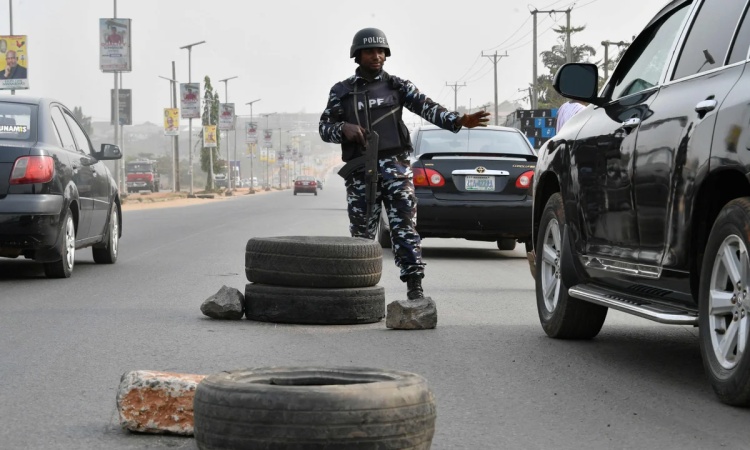
Armed policemen flag down a vehicle
For millions of Nigerians, the fear of crime no longer ends with criminals. Increasingly, it begins at police checkpoints, traffic stops, and routine “stop-and-search” encounters that have become scenes of alleged extortion, intimidation, and profiling.
Many citizens recount experiences where officers single out innocent travellers based on how they look, dress, speak, or the vehicles they drive, using vague suspicions as leverage to demand money.
What should be lawful security checks, they say, have gradually turned into daily ordeals where refusal to “settle” is met with threats of detention, seizure of phones or vehicles, or the fabrication of allegations.
A recent case that sparked national attention involved a couple travelling from Lagos in December 2025.
According to reports, they were stopped by officers at a checkpoint in Ogudu, allegedly accused of carrying suspicious funds, and asked to pay $2,000 (N3.3 million) before being released.
The couple was intimidated and separated during questioning, with officers allegedly reviewing their belongings and phones.
After public outcry and media coverage, the Lagos State Police Command confirmed that the officers had been identified and detained, and that a partial refund of N2.2 million had been returned to the victims. The command further stated that an investigation was ongoing, and that disciplinary action would follow.
This incident illustrates how extortion is not just a financial burden but a deeply personal and distressing ordeal that can shake the sense of safety for ordinary citizens.
Police extortion is not confined to Lagos. Across Nigeria, from the South-East to the North-Central region, from the South-South to parts of the North-East, similar complaints are routine. Commercial drivers speak of paying at almost every checkpoint along major highways.
Private motorists describe being stopped multiple times within short distances. Interstate travellers recount being detained for hours over vague accusations that disappear once money changes hands. Citizens say the pattern is increasingly predictable: officers’ profile first, intimidate next, and demand payment last.
In many parts of the country, checkpoints that were originally justified as security measures have allegedly become informal toll points. Travellers say the demands vary depending on perceived wealth, accent, or even the confidence with which a citizen speaks.
For some, refusal to pay leads to prolonged detention; for others, it escalates into threats of arrest or the seizure of personal belongings.
The psychological toll of these encounters is profound. Families travelling for weddings, funerals, or religious events often approach police checkpoints with fear rather than reassurance. Women report verbal harassment and intimidation. Young Nigerians say they are frequently profiled based on clothing, hairstyles, or possession of smartphones and laptops.
Over time, many have learned to carry “settlement money” as a precaution, accepting extortion as part of movement in the country.
Beyond personal trauma, police extortion carries significant economic consequences. Transporters factor illegal payments into their operating costs, which are eventually transferred to passengers and consumers as fares.
Small business owners complain that inter-state logistics have become more expensive and unpredictable. In rural areas, traders sometimes abandon safer or shorter routes to avoid known extortion points, increasing travel time and expenses. The cumulative effect is widespread distrust of the police.
Effective policing relies heavily on cooperation, intelligence sharing, and voluntary compliance from citizens. However, when law enforcement officers are perceived as predators rather than protectors, communities withdraw. Crimes go unreported, witnesses stay silent, and the gap between the police and the public widens, undermining national security efforts.
Police authorities have repeatedly responded to allegations of extortion with public assurances. Officers caught on camera or exposed through social media are often said to have been identified, detained, or placed under investigation.
In some cases, victims have reportedly received refunds after public outcry. Yet these responses have done little to convince the public that meaningful accountability exists. Many Nigerians argue that what follows such announcements is rarely made public.
Officers are sometimes transferred, redeployed, or quietly reinstated. Prosecutions are uncommon, and disciplinary outcomes are rarely transparent.
This lack of openness has reinforced the perception that extortion is only punished when it becomes a public embarrassment.
Social media has emerged as an informal accountability tool, forcing rapid responses where formal complaint mechanisms have failed.
Videos, live streams, and testimonies shared online have led to swift interventions and refunds in some cases. However, reliance on digital exposure has its limitations. Not every victim can safely record encounters with armed officers, and justice should not depend on virality.
Experts argue that police extortion is sustained by a combination of weak supervision, inadequate welfare for junior officers, poor enforcement of internal regulations, and limited civilian oversight.
While low pay is often cited as a contributing factor, critics insist that economic hardship cannot justify systematic abuse of authority.
Legal practitioners note that extortion, unlawful detention, and profiling violate several provisions of Nigerian law, including constitutional guarantees of personal liberty and freedom of movement. They argue that internal discipline alone is insufficient and that criminal prosecution of offending officers would serve as a stronger deterrent.
Across the country, ordinary Nigerians continue to share similar stories. Motorists recount being accused of imaginary traffic offences. Travellers speak of being threatened with fabricated charges.
Commercial drivers describe checkpoints as unavoidable obstacles where payment is expected, not requested. These experiences, repeated daily across regions, point to a crisis that has become normalised.
As Nigeria continues to battle insecurity and economic hardship, the persistence of police extortion raises serious questions about the future of law enforcement and public trust. Citizens are being asked to cooperate with security agencies while simultaneously navigating fear, humiliation, and financial loss at the hands of those agencies.
The widely reported extortion cases of recent months should serve as a wake-up call rather than a fleeting scandal. Without sustained reform, transparent accountability, and firm consequences for abuse, the cycle will continue.
Every checkpoint will remain a gamble, every journey a negotiation, and every uniform a symbol viewed with suspicion rather than confidence.
Until the culture of extortion is confronted head-on, millions of Nigerians will continue to experience law enforcement not as protection, but as an ordeal endured simply to move from one place to another. (Daily Independent)