
ADVERTISEMENT

ADVERTISEMENT

ADVERTISEMENT

ADVERTISEMENT

























Loading banners


NEWS EXPRESS is Nigeria’s leading online newspaper. Published by Africa’s international award-winning journalist, Mr. Isaac Umunna, NEWS EXPRESS is Nigeria’s first truly professional online daily newspaper. It is published from Lagos, Nigeria’s economic and media hub, and has a provision for occasional special print editions. Thanks to our vast network of sources and dedicated team of professional journalists and contributors spread across Nigeria and overseas, NEWS EXPRESS has become synonymous with newsbreaks and exclusive stories from around the world.
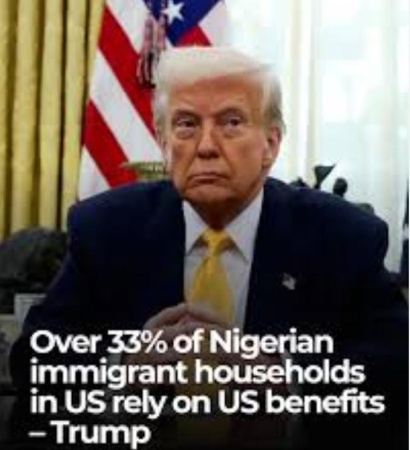
This analysis dismantles the viral claim that 33.3% of Nigerian immigrant households in the U.S. rely on welfare. By examining data from the Migration Policy Institute and the Cato Institute, the article reveals that the statistic is misleadingly calculated on a “household” basis, often counting U.S.-born citizen children rather than the immigrants themselves. ODIMEGWU ONWUMERE in the investigation shows evidence that Nigerian immigrants are among the most highly educated groups in America, contributing more in taxes than they consume in services. The article traces that ultimately, the narrative of dependency is refuted by strict eligibility laws and the community’s high workforce participation.
In the age of digital diplomacy and rapid-fire political messaging, a single chart can travel the globe before the truth has even begun to put on its shoes. This reality was laid bare when United States President Donald Trump shared a data visualization claiming that roughly 33.3 per cent of Nigerian immigrant households in the U.S. utilize public assistance. On the surface, the figure is startling—a neat, mathematical soundbite that suggests a significant level of dependency. However, beneath the bold font and the viral headlines lies a sophisticated distortion of data that ignores the nuances of American law, the reality of household structures, and the undeniable economic contributions of the Nigerian diaspora.
To understand why this figure is so misleading, one must first dismantle the “household” metric. In the eyes of U.S. data collectors, a household is flagged as receiving public assistance if a single individual within that home accesses any government-funded program. This is a critical distinction that independent analysts have frequently highlighted when discussing how statistics can be used to inflate perceptions of dependency.
A Nigerian immigrant household often includes U.S.-born children who are citizens by birthright. If a child receives a subsidized school lunch or a state-funded health check-up, the entire household—including the high-earning, tax-paying parents—is counted in that 33.3 per cent bracket. The statistic, therefore, measures the participation of American children in American social safety nets, rather than a lack of self-sufficiency among Nigerian adults.
The claim survives on a profound misunderstanding of the Public Charge Rule and the stringent eligibility laws governing U.S. benefits. For the vast majority of lawful permanent residents, there is a mandatory five-year waiting period before they can even apply for federal assistance programs like SNAP (Supplemental Nutrition Assistance Program) or Medicaid. Many immigrants never qualify for these benefits at all. This legal barrier creates a paradox for the President’s claim: how can a group be “dependent” on a system they are largely barred from entering?
When we pull back the lens to view the broader economic landscape, the narrative of “the immigrant burden” falls apart. Data from the Cato Institute reveals a starkly different reality: immigrants across the board use significantly less welfare than native-born Americans. Specifically, Cato found that immigrants consume roughly 21 per cent less in benefits than citizens born in the U.S. This isn’t just a matter of law; it’s a matter of cultural and economic drive.
For Nigerian immigrants, the story is one of exceptional academic and professional achievement. Research from the Migration Policy Institute consistently shows that sub-Saharan African immigrants, with Nigerians at the forefront, are among the most highly educated groups in the United States. They are significantly more likely to hold bachelor’s or advanced degrees than the general U.S. population and are over-represented in vital sectors such as medicine, engineering, and nursing.
The economic contribution of these individuals is a two-way street that the viral chart conveniently ignores. Immigrants are not just consumers of services; they are the financiers of them. Through payroll, property, sales, and income taxes, Nigerian immigrants contribute billions to the very programs they are accused of draining.
Even those without permanent status often pay into Social Security using Taxpayer Identification Numbers, funding a retirement system they may never be allowed to access. In this light, the immigrant household is frequently a net creditor to the U.S. Treasury, paying in far more than it ever takes out in the form of a subsidized school meal or a clinic visit.
There is also the pressing issue of journalistic integrity regarding the source of the 33.3 per cent figure. As noted by Nigeria Info, the chart was posted without a verifiable citation from a peer-reviewed study or a recognized government agency like the U.S. Census Bureau.
Without knowing the specific year the data was collected, the exact programs included, or the income thresholds used, the number is less of a ”fact” and more of a “framed perception.” In data science, “garbage in, garbage out” is a foundational rule; when a statistic lacks transparency, it cannot be used to pass judgment on a community of millions.
Ultimately, the focus on welfare use as a metric of “worth” creates a double standard. Public assistance is designed as a bridge—a tool to help families navigate medical emergencies, job transitions, or the costs of raising the next generation of American workers. When native-born Americans use these programs, it is viewed as a social safety net In action. When immigrants use them, it is often weaponized as a political talking point.
The real story of Nigerian immigrants in America is not found in a poorly explained percentage. It is found in the doctors working in rural American hospitals, the professors in Ivy League classrooms, and the entrepreneurs revitalizing American main streets.
These are households that work hard, pay their dues, and invest in the future of their new home. A single, decontextualized statistic may make for a loud headline, but it can never drown out the quiet, steady reality of immigrant success and the massive net positive they represent for the American economy.
The truth Is far simpler: Nigerian immigrants are not a burden on the system; they are one of the most vibrant engines keeping it running.
•Onwumere is Chairman, Advocacy Network On Religious And Cultural Coexistence ANORACC.


