Updating your news feed...
NEWS EXPRESS is Nigeria’s leading online newspaper. Published by Africa’s international award-winning journalist, Mr. Isaac Umunna, NEWS EXPRESS is Nigeria’s first truly professional online daily newspaper. It is published from Lagos, Nigeria’s economic and media hub, and has a provision for occasional special print editions. Thanks to our vast network of sources and dedicated team of professional journalists and contributors spread across Nigeria and overseas, NEWS EXPRESS has become synonymous with newsbreaks and exclusive stories from around the world.






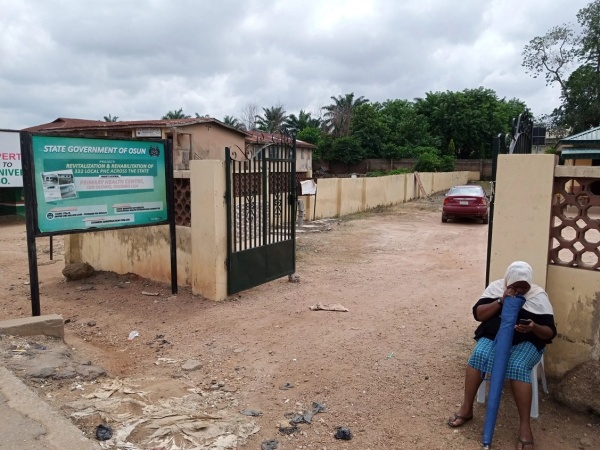
A primary healthcare centre in Osun State
Osun State’s primary healthcare system is on the brink of collapse, with 73 per cent of Primary Health Centres (PHCs) operating with zero to one health worker, effectively cutting millions of residents off from basic medical care and exposing deep structural weaknesses in the state’s health delivery system.
Findings from a recent report by CheckMyPHC.org, a platform that aggregates and analyses primary healthcare data nationwide, further revealed that 44 per cent of PHCs across the state operate without a single health worker, leaving a large number of facilities unable to function effectively.
Osun has over 600 PHCs, including about 332 designated as focal centres meant to provide round-the-clock services. However, the report found that more than 90 per cent of these centres remain severely understaffed and poorly equipped, despite their role as the first point of contact for healthcare delivery, particularly in rural communities.
According to the data, the state currently requires an estimated 9,000 additional health workers to meet basic operational needs.
Yet, no significant recruitment exercise has been undertaken in recent years to bridge the widening gap.
The National Primary Health Care Development Agency (NHPCDA) stipulates that each PHC should have a minimum of 10 staff, including doctors, nurses or midwives, community health officers, community health extension workers, laboratory technicians, pharmacy technicians and medical records officers.
Public health experts warn that the staffing crisis has serious consequences for patient care and public health outcomes. With little or no personnel, consultations are rushed or unavailable, diagnoses are delayed or missed, and preventable illnesses go untreated. Weak staffing also undermines disease surveillance, immunisation programmes and community outreach, increasing the risk of outbreaks going undetected.
The report also highlighted major infrastructural deficits across many PHCs. Several facilities lack clean water, functional toilets and basic hygiene materials. In some centres, nurses and patients reportedly rely on well water or unsafe sources for deliveries, sterilisation and handwashing, raising concerns about infection control and patient safety.
Health stakeholders argue that the situation worsened following the dismissal of over 2,000 health workers recruited under the administration of former Governor Adegboyega Oyetola, noting that no replacements have been made since Governor Ademola Adeleke assumed office. They say the decision left many PHCs deserted and stretched the few remaining workers beyond capacity.
Speaking on the crisis, Dr. Austine Aipoh, the president of the Healthcare Providers Association of Nigeria (HCPAN), blamed poor working conditions, insecurity and unreliable power supply for the exodus of health professionals.
According to him, once young healthcare professionals acquire some experience, many leave in search of better opportunities. “This hits all levels, be it primary health centres, general hospitals, teaching hospitals, and even private facilities. It is a crisis. The government must act to keep our doctors here and encourage Japada. Beyond pay, insecurity, poor social services, and no reliable electricity drive nurses away. That is why primary health centres are often empty,” Aipoh stated.
Aipoh further warned that the situation has grave implications for ordinary citizens, especially those in rural communities who rely heavily on public health facilities. “The consequences are clear: Nigeria’s health stats will keep worsening. They are already bad. If over half our trained doctors leave, we will never hit our 2030 universal health coverage goal.
“The health of ordinary people will suffer most. The rich can afford private hospitals, but the poor, especially in rural areas like Osun, will be left with understaffed primary centres meant to bring care to every corner. What I expect from the government: Show willpower. Fix electricity for healthcare, boost security, and build affordable social infrastructure. If they can earn well, live safely, and thrive at home, many will stay. After all, home is home, no matter how good things are elsewhere,” Aipoh stated.
Corroborating these concerns, a member of the Nigerian Union of Allied Health Professionals in Osun State said long waiting hours and the absence of skilled personnel discourage residents from seeking care. He warned that maternal and child mortality rates are rising due to poor antenatal services, unsafe deliveries and delayed emergency responses.
He also cautioned that overstretched workers face burnout, while essential services such as immunisation, family planning and laboratory testing are often unavailable or irregular. “Understaffed PHCs struggle with health education and disease monitoring, which can lead to late detection of outbreaks,” he said.
As warnings mount, health experts are calling on the Osun State Government to urgently recruit health workers, rehabilitate PHC infrastructure and improve working conditions to prevent a complete breakdown of primary healthcare services. (Business Day)