
Updating your news feed...
NEWS EXPRESS is Nigeria’s leading online newspaper. Published by Africa’s international award-winning journalist, Mr. Isaac Umunna, NEWS EXPRESS is Nigeria’s first truly professional online daily newspaper. It is published from Lagos, Nigeria’s economic and media hub, and has a provision for occasional special print editions. Thanks to our vast network of sources and dedicated team of professional journalists and contributors spread across Nigeria and overseas, NEWS EXPRESS has become synonymous with newsbreaks and exclusive stories from around the world.























Loading banners
Loading banners...

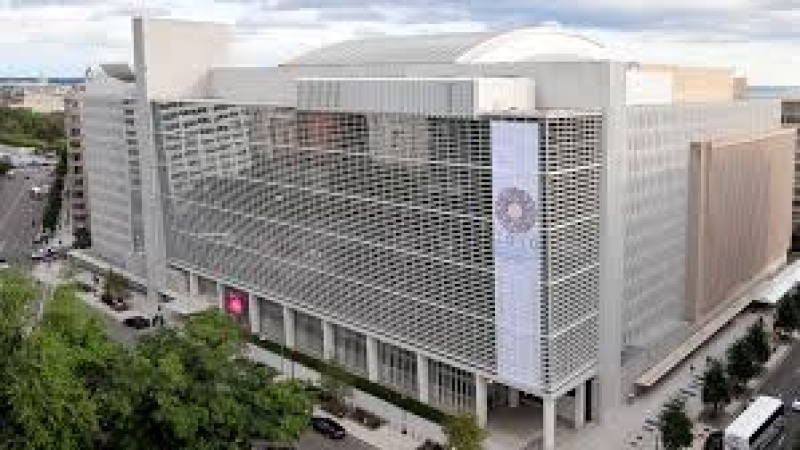
World Bank headquarters, Washington DC
The Federal Government, in collaboration with the World Bank, is implementing the Human Capital Opportunities for Prosperity and Equity–Governance (HOPE-GOV) Program, a US$500 million credit facility designed to improve financial and human resource management in basic education and primary healthcare.
The National Coordinator of the HOPE-Governance Program, Dr. Assad Hassan, disclosed this on Tuesday in Abuja while briefing the Permanent Secretary of the Federal Ministry of Budget and Economic Planning, Dr. Deborah O. N. Odoh, where the HOPE-Governance Program is domiciled.
“In terms of program financing and scope, it’s a World Bank assisted credit of $500 million, which is split into two components. One is the Program for Result while the second is Investment Project Financing.
“$480 million is earmarked to incentivize the States to achieve the Disbursement Linked Results in the two sectors while $20 million Investment Project Financing component has three key areas for implementation. One is program coordination, second is verification of results at the state level as well as monitoring and evaluation and third is technical assistance for implementing agencies i.e. the states, UBEC, Ministerial Oversight Committee of the Basic Health Care Provision Fund at the Federal Ministry of Health and Social Welfare, and the Federal Ministry of Budget and Economic Planning,” he said.
Dr. Assad identified the program’s key focus areas as increasing financing for the two sectors, enhancing transparency and accountability in budgeting and audit for basic education and primary healthcare, and supporting the recruitment of teachers and primary healthcare workers to address manpower gaps in both sectors.
“For HOPE-Governance, our primary objective is to see how we improve financial and human resource management in these two sectors by focusing on three key areas: the first is increase in funding for the two sectors. In this regard, we are working with the Universal Basic Education Commission as well as the Ministerial Oversight Committee, Basic Health Care Provision Fund in the Federal Ministry of Health and their counterparts at the states level.
“Then the second key area is enhance transparency and accountability in budget for both sectors, audit report, citizens format budget. Basically it’s about public financial management in the two sectors.
“Then the third and final area. We want to see improved recruitment and retention of teachers as well as primary health workers,” he stated.
According to Dr. Assad Hassan, the states have six Disbursement Linked Indicators, which would be tracked by the HOPE-Governance Program and appraised by Independent Verification Agents before funds are released to the states.
Providing the historical background of the Program, the National Coordinator explained that the World Bank approved the HOPE-GOV Program on 26 September 2024, following the successful negotiation of the Financing Agreement in August 2024.
He added that the Federal Executive Council (FEC) granted approval in February 2025, the Financing Agreement was countersigned by the Federal Government in April 2025, and the Program was subsequently declared effective in September 2025.
He stated that, to date, all 36 states of the Federation and the Federal Capital Territory (FCT) have expressed interest in participating in the Program, and the Subsidiary Agreements have been dispatched to the states for signing.
The National Coordinator clarified that under the Program for Result, the state governments are expected to invest in the Disbursement Linked Indicators and they get incentivized by the Program.
“The way the Program is designed, you achieve something this year and you get incentivized so that you put that money back to work on the second-year results,” he said.
He said the Program will soon hire Interim Verification Agents who would verify the first-year results by the state governments.
In her response, the Permanent Secretary of the Federal Ministry of Budget and Economic Planning, Dr. Deborah O. N. Odoh, expressed her readiness to support to the Program to attain its objectives.
She also commended the Programme for the achievements recorded within its short period of implementation. (Daily Trust)




