Updating your news feed...
NEWS EXPRESS is Nigeria’s leading online newspaper. Published by Africa’s international award-winning journalist, Mr. Isaac Umunna, NEWS EXPRESS is Nigeria’s first truly professional online daily newspaper. It is published from Lagos, Nigeria’s economic and media hub, and has a provision for occasional special print editions. Thanks to our vast network of sources and dedicated team of professional journalists and contributors spread across Nigeria and overseas, NEWS EXPRESS has become synonymous with newsbreaks and exclusive stories from around the world.





Loading banners
Loading banners...

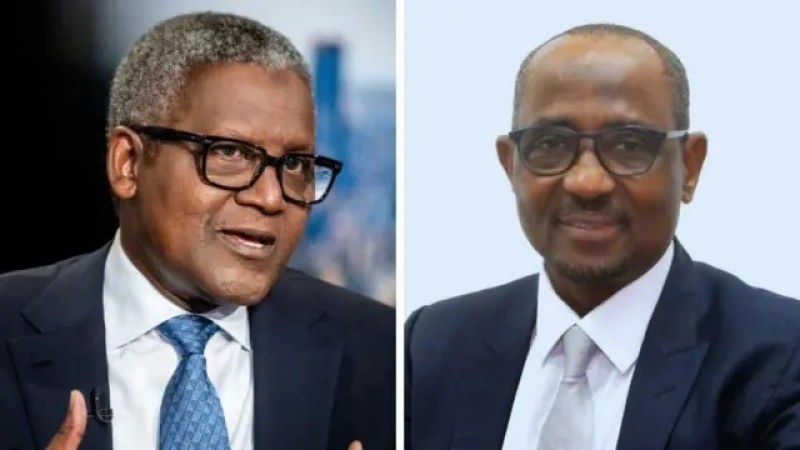
Aliko Dangote, Farouk Ahmed
By ABDULRAZAQ MAGAJI
In a country where wealth often buys graveyard silence and where proximity to power guarantees unfettered protection, Alhaji Aliko Dangote’s recent posture as an activist and combative public critic of Nigeria’s petroleum sector is both startling and instructive. Africa’s richest man did not set out to be an activist, much less a whistleblower. Yet the internecine oil war that has erupted around his $20 billion Dangote Refinery has pushed him into an unlikely and reluctant crusader to confront entrenched vested interests determined to preserve a much-vilified lucrative status quo in the oil and gas sector.
Issues came to a head on December 14, 2025, when Nigerians were treated to an allegation by Aliko Dangote that the Chief Executive Officer of the Nigerian Midstream and Downstream Petroleum Regulatory Authority (NMDPRA), Farouk Ahmed, spent about $5 million on the secondary school education of his four children in Switzerland, and called for a full investigation and a public explanation. The way things stand, it appears Dangote is set to blow his whistle even louder on other industry players who benefit from the status quo.
At the heart of this conflict lies a simple but uncomfortable truth. Nigeria’s petroleum sector, despite decades of reforms and billions of dollars, remains one of the most captured spaces in the national economy. It is one sector where transparency is alien, where inefficiency is dollarised, and where national interest is routinely subordinated to private gain. The multi-billion Dangote refinery project, which was conceived as a solution to Nigeria’s chronic fuel import dependency, has inadvertently threatened these arrangements. Few Nigerians will deny that the backlash from vested interests to Dangote Refinery was inevitable.
For years, Nigeria has lived with the absurdity of being Africa’s largest crude oil producer while importing nearly all its refined petroleum products. This anomaly has enriched a small cabal of fuel importers, subsidy profiteers, shipping middlemen, and regulatory fixers and, as shown in the past, any attempt to disrupt this lucrative ecosystem was bound to provoke resistance. With domestic refining which has the potential to reduce foreign exchange pressure and ensure energy stability and security, Dangote’s refinery, with a capacity of 650,000 barrels per day, with plans to increase its output to 1.4 million barrels per day, represents the most serious attempt yet to reposition this rent-based economy. But it also promises to give a bloody nose to vested interests that have grown fat off dysfunction and who are not prepared to give in without a fight.
What has shocked many Nigerians is not that these interests are fighting back, but the brazenness with which they are doing so. Since the refinery became operational, Aliko Dangote has publicly accused elements within the regulatory and trading system of sabotaging his refinery through policy somersaults, selective enforcement, and outright hostility. From disputes over crude oil supply to sudden changes in import rules and pricing frameworks, the message to Aliko Dangote has been clea’: shape in or ship out!
That Dangote has chosen to air these grievances publicly marks a radical departure from the traditional behaviour of Nigeria’s business elite. Typically, such disputes are settled quietly in boardrooms through backchannels, compromises, or elite bargaining. Dangote, however, seems to have concluded that silence is no longer an option. If truth be told, when a man like Aliko Dangote, who has benefited immensely from Nigeria’s system begins to describe that same system as compromised, Nigerians should pay attention.
Critics are quick to point out that Dangote himself is no saint. They argue, not without reason, that he enjoys monopolistic advantages in other sectors, from cement to sugar, often enabled by favourable government policies. Valid and necessary as the criticism is, it neither rubbishes nor invalidate the substance of his claims. In almost all human endeavours, one does not need to be morally perfect to expose a structural rot. Indeed, it is precisely because Dangote understands how power works in Nigeria that his warnings carry weight.
There is also a cruel irony in the situation. Successive governments have lamented capital flight, foreign exchange scarcity, and the vulnerability created by fuel imports that Nigerians are often told favour an insignificant few. How come then, that immediately a Nigerian investor sinks unprecedented capital, as against the counsel of some of his friends, into solving this self-imposed problem, then system and those who should support him respond with hostility! In this is a contradiction that reveals a state that Is rhetorically committed to self-sufficiency but practically addicted to rent-seeking. Clearly, the oil war suggests that Nigeria’s greatest challenge is not lack of ideas or capital, but the stranglehold of interests that profit from corruption and inefficiency.
It Is noteworthy that Dangote’s public outbursts also raise valid and uncomfortable questions about the limits or otherwise of reforms in Nigeria. If one may ask, if Africa’s wealthiest industrialist, with access to the highest levels of power across the globe, can almost be kneecapped, cajoled and stretched to his limits, what hope is there for smaller investors or innovators? In becoming an activist by circumstance, therefore, Aliko Dangote has definitely forced a national conversation that policymakers have long sidestepped, chiefly among them, who truly benefits from Nigeria’s petroleum regime? Why is domestic refining so difficult to sustain in Nigeria? And why do regulatory decisions often appear designed to protect middlemen rather than consumers or producers? These are questions that strike at the underbelly of Nigeria’s governance crisis.
Already, opponents and supporters have started adopting positions that threaten to reduce this battle into a personality clash rather than seeing it as a systemic reckoning. Highlighting the issue as “Dangote versus the oil cabal”, as some Nigerians have chosen to believe, risks simplifying a complex problem and allowing institutions to escape scrutiny. The real issue in this battle is not whether Dangote wins or loses, but whether Nigeria finally dismantles a petroleum order built on ineptitude, speculations and absolute lack of transparency.
This is one battle that government cannot afford to play the role of an assumed disinterested spectator. If anything, the unfolding drama presents an opportunity for the government to pitch tent, not between Dangote and his adversaries, but between reform and deform. What is being said here is that, protecting domestic refining, ensuring fair access to crude, and enforcing transparent regulation should not be seen as favours to Dangote; rather, they should be regarded as obligations to the Nigerian people, and facing in that regard will firm suspicions that vested interests, not public policy, still run Africa’s largest oil economy.
This storm will pass and, with its passing, Alhaji Aliko Dangote will return to his comfort zone as a quiet industrialist. Either way the dust settles, what will not go away is that a billionaire has been forced to sound this alarm to confirm the fear that the real oil war is about the soul of Nigeria’s economy.
•Magaji magaji778@gmail.com writes from Abuja.