
Updating your news feed...
NEWS EXPRESS is Nigeria’s leading online newspaper. Published by Africa’s international award-winning journalist, Mr. Isaac Umunna, NEWS EXPRESS is Nigeria’s first truly professional online daily newspaper. It is published from Lagos, Nigeria’s economic and media hub, and has a provision for occasional special print editions. Thanks to our vast network of sources and dedicated team of professional journalists and contributors spread across Nigeria and overseas, NEWS EXPRESS has become synonymous with newsbreaks and exclusive stories from around the world.







Loading banners
Loading banners...

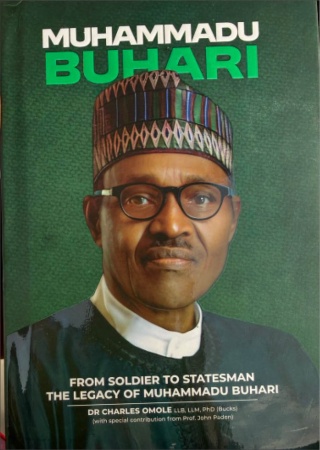
A newly released book has offered fresh insight into the power struggles that defined the ruling All Progressives Congress (APC) ahead of the 2023 presidential primaries, revealing how a powerful cabal around late former President Muhammadu Buhari allegedly sought to install then Senate President Ahmad Lawan as the party’s consensus candidate by attempting to manipulate the country’s security architecture.
The account, contained in From Soldier to Statesman: The Legacy of Muhammadu Buhari by Dr Charles Omole, details a failed plot in which senior security chiefs were allegedly pressured with a purported “presidential order” to deploy forces to impose Lawan at the APC presidential primary in Abuja.
The book, launched on Monday at the Presidential Villa, Abuja, chronicles Buhari’s military career, political life and the internal dynamics of his administration, particularly during the tense months leading to the 2023 general elections.
Contrary to widespread speculation at the time, Omole writes that Buhari neither endorsed Lawan nor authorised any security intervention to influence the outcome of the APC primaries. Instead, the author argues that individuals close to the president repeatedly sought to exploit his authority, often without his knowledge, to advance their preferred political outcomes.
The cabal and the consensus plot
According to the book, the push to make Lawan the APC’s consensus candidate was driven by what the author described as an anti–Bola Ahmed Tinubu consensus among a powerful cabal within the Buhari administration.
While Tinubu, a former Lagos State governor, eventually emerged as the APC’s presidential candidate, the book suggests that several influential figures around Buhari viewed his ambition with suspicion and worked behind the scenes to stop him.
“The cabal aimed to impose a candidate at the APC primary,” Omole wrote, noting that Lawan was widely considered their preferred option. “Ironically, Buhari’s strict enforcement of the rules may have indirectly aided Tinubu, as his fastidiousness repeatedly thwarted the cabal’s plans to impose another candidate.”
The most dramatic episode, as recounted in the book, involved an alleged attempt to use the security services to give effect to the cabal’s plans.
In a section titled Aides, Primaries, and a Fake Presidential Order, Omole narrates how, on the eve of the APC presidential primaries in Abuja, some influential figures close to the president approached the nation’s top security chiefs with what they claimed was a directive from Buhari.
Those approached, according to the book, were the Inspector-General of Police (IGP), the Director-General of the Department of State Services (DSS), and the Director-General of the National Intelligence Agency (NIA).
“They relayed a presidential ‘order’ to the trio to deploy security forces to install Sen. Lawan as the APC presidential candidate, as the consensus candidate,” the book stated.
A meeting was reportedly scheduled to finalise the plan — a move Omole described as relying on “proximity to power and the intimidation of uniforms”.
However, the plot began to unravel when the then IGP, Alkali Baba, refused to participate.
“He told his colleagues he would not be part of it,” Omole wrote. “So, the trio decided to seek an urgent audience with the President.”
Confronting the President
When the security chiefs were ushered in to see Buhari, the IGP led the discussion, maintaining what the book described as a professional tone.
They informed the president that security arrangements for the APC convention at Eagle Square were already in place. Buhari reportedly acknowledged this and offered no additional instructions.
At that point, the IGP raised the issue that had prompted the emergency meeting. From his residence, he said, he could hear celebrations in his neighbourhood following reports that Buhari had endorsed Lawan as his preferred candidate. The IGP lives next to the official guest house of the Senate President.
“The President laughed,” Omole wrote. “And then he made it clear: he had not anointed anyone.”
According to the account, Buhari reiterated a position he had consistently maintained: that Nigerians, including party delegates, must be allowed to choose their leaders freely, and that the security services must not interfere in that process.
“He repeated what he had always said; Nigerians should choose, and they must not interfere with the wishes of the party voters,” the book stated.
Outside the president’s inner office, those alleged to have orchestrated the plan were waiting. The IGP reportedly informed them directly that Buhari had no candidate and had issued no such directive.
“There will be no manipulation from the Villa through the security services,” Omole wrote, adding that the attempted misrepresentation “died where it should, at the threshold of a President’s conscience”.
The account was later corroborated by the then Director-General of the DSS, Yusuf Magaji Bichi, during an interview conducted for the book.
Buhari and the use of force
Beyond the APC primaries, Omole presents Buhari as deeply cautious about the political use of coercive power, particularly the security services.
“A presidency’s character is revealed in the way it treats elections,” the book stated, “not in speeches, but in instructions to those who carry guns.”
The author recounts a meeting held in the run-up to the 2023 general elections involving the National Security Adviser, the service chiefs, the DSS director-general and the IGP.
At the meeting, Buhari reportedly told them he would once again make it clear at the APC’s final caucus meeting that Nigerians must be allowed to vote for candidates of their choice.
“Their job,” Buhari was quoted as saying, “was to ensure the security that would make that choice real,” adding that he would provide the necessary funding to do so.
Osinbajo, Tinubu and internal tensions
The book also sheds light on Buhari’s attitude towards other key aspirants, including former Vice President Yemi Osinbajo.
According to Omole, Buhari was not supportive of Osinbajo’s presidential ambition and found it difficult to understand why his deputy would contest against Tinubu.
Quoting accounts attributed to former First Lady Aisha Buhari, Omole said Buhari regarded Tinubu as Osinbajo’s political benefactor.
“I don’t know Osinbajo from anywhere,” Buhari was quoted as telling his allies. “I met him only through Tinubu.”
The book adds that Buhari was reportedly displeased that Osinbajo did not consult him before declaring his ambition, but merely informed him.
“The president was quoted as having wondered how his vice president could go against his benefactor in such an open way,” Omole wrote.
Tinubu’s eventual emergence as APC candidate, the author noted, was widely perceived as a reward for his role as a political godfather and major financier of the party.
Aisha Buhari and the cabal
The book also reveals that Aisha Buhari’s open support for Tinubu angered some powerful figures within the cabal, but that the former first lady remained undeterred.
According to Omole, Tinubu later visited Aisha Buhari and sought her support in mobilising women for his campaign alongside his wife, Sen. Remi Tinubu.
“She agreed, and the APC Women’s Campaign Council was established,” the book stated.
In concluding the account, Omole warns of the dangers posed by individuals who allegedly exploited Buhari’s trust and authority.
“This again shows how people close to Buhari exploited his trust and misrepresented him to harm the nation, without Buhari’s knowledge,” the author wrote.
He added that the consequences could have been severe if the security chiefs had acted on the false directive without verifying it directly with the president.
“Imagine what could have happened if the IGP had not insisted on hearing from the President directly,” Omole wrote. “He and others might have acted on a non-existent presidential order.”
The author further noted that several similar instances of false presidential directives were reported during the Buhari administration, underscoring what he described as a recurring problem of access, influence and misrepresentation at the highest levels of power. (Daily Trust)




