ADAD
ADAD
Updating your news feed...
NEWS EXPRESS is Nigeria’s leading online newspaper. Published by Africa’s international award-winning journalist, Mr. Isaac Umunna, NEWS EXPRESS is Nigeria’s first truly professional online daily newspaper. It is published from Lagos, Nigeria’s economic and media hub, and has a provision for occasional special print editions. Thanks to our vast network of sources and dedicated team of professional journalists and contributors spread across Nigeria and overseas, NEWS EXPRESS has become synonymous with newsbreaks and exclusive stories from around the world.













Loading banners
Loading banners...

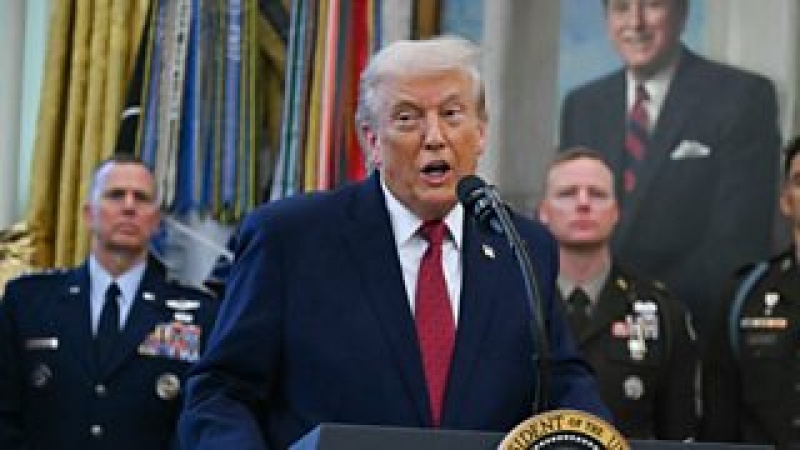
The BBC has said it will defend a $5bn (£3.7bn) lawsuit filed by US President Donald Trump against the BBC over an edit of his 6 January 2021 speech in a Panorama documentary.
Trump accused the broadcaster of defamation and of violating a trade practices law, according to court documents filed in Florida.
The BBC apologised to Trump last month, but rejected his demands for compensation and disagreed there was a "basis for a defamation claim".
Trump's legal team accused the BBC of defaming him by "intentionally, maliciously, and deceptively doctoring his speech".
A BBC spokesperson said: "As we have made clear previously, we will be defending this case."
"We are not going to make further comment on ongoing legal proceedings."
Trump said last month he planned to sue the BBC for the documentary, which aired in the UK ahead of the 2024 US election.
"I think I have to do it," Trump told reporters then of his plans. "They cheated. They changed the words coming out of my mouth."
In his speech on 6 January 2021, before a riot at the US Capitol, Trump told a crowd: "We're going to walk down to the Capitol, and we're going to cheer on our brave senators and congressmen and women."
More than 50 minutes later in the speech, he said: "And we fight. We fight like hell."
In the Panorama programme, a clip showed him as saying: "We're going to walk down to the Capitol... and I'll be there with you. And we fight. We fight like hell."
The BBC acknowledged the edit had given "the mistaken impression" he had "made a direct call for violent action", but disagreed that there was basis for a defamation claim.
In November, a leaked internal BBC memo criticised how the speech was edited, and led to the resignations of the BBC's director general, Tim Davie, and its head of news, Deborah Turness.
Before Trump filed the lawsuit, lawyers for the BBC had given a lengthy response to the president's claims.
They said there was no malice in the edit and that Trump was not harmed by the programme, as he was re-elected shortly after it aired.
They also said the BBC did not have the rights to, and did not, distribute the Panorama programme on its US channels. While the documentary was available on BBC iPlayer, it was restricted to viewers in the UK.
In his lawsuit, Trump cites agreements the BBC had with other distributors to show content, specifically one with a third-party media corporation that allegedly had licensing rights to the documentary outside the UK. The BBC has not yet responded to these claims, nor has the company with the alleged distribution agreement.
The lawsuit also claims people in Florida may have accessed the programme using a VPN or by using streaming service BritBox.
"The Panorama Documentary's publicity, coupled with significant increases in VPN usage in Florida since its debut, establishes the immense likelihood that citizens of Florida accessed the Documentary before the BBC had it removed," the lawsuit said.
Health minister Stephen Kinnock said the BBC was right to "stand firm" in the face of Trump's lawsuit.
"I think they have apologised for one or two of the mistakes that were made in that Panorama programme, but they've also been very clear that there is no case to answer in terms of Mr Trump's accusations on the broader point about libel or defamation," he told Sky News.
He said the Labour Party would "always stand up for the BBC as a vitally important institution".
Nigel Huddleston, shadow culture secretary, said the prime minister should "use his apparent influence to explain to the president that suing the BBC will negatively impact the licence fee payer".
Liberal Democrat leader Sir Ed Davey urged Sir Keir Starmer to tell Trump his decision to sue the BBC was "unacceptable".
This is the latest in a series of lawsuits Trump has filed against news organisations.
He has previously sued several US media companies for large sums of money, securing multi-million dollar settlements in some cases.
Chris Ruddy, founder and chief executive of conservative US media outlet Newsmax Media, and an ally of Trump, told the BBC it was difficult to win a defamation lawsuit in the US as "the bar is very high".
But he suggested the BBC should reach a settlement to avoid the cost of litigation, which he estimated could reach between $50m (£37m) and $100m (£74m).
Former BBC Radio controller Mark Damazer said it would be "extremely damaging to the BBC's reputation not to fight the case".
"This is about the BBC's independence and, unlike American media organisations which have coughed up the money, the BBC doesn't have commercial business interests that depend on President Trump's beneficence in the White House," he told BBC Radio Four's Today programme. (BBC)