Updating your news feed...
NEWS EXPRESS is Nigeria’s leading online newspaper. Published by Africa’s international award-winning journalist, Mr. Isaac Umunna, NEWS EXPRESS is Nigeria’s first truly professional online daily newspaper. It is published from Lagos, Nigeria’s economic and media hub, and has a provision for occasional special print editions. Thanks to our vast network of sources and dedicated team of professional journalists and contributors spread across Nigeria and overseas, NEWS EXPRESS has become synonymous with newsbreaks and exclusive stories from around the world.













Loading banners
Loading banners...

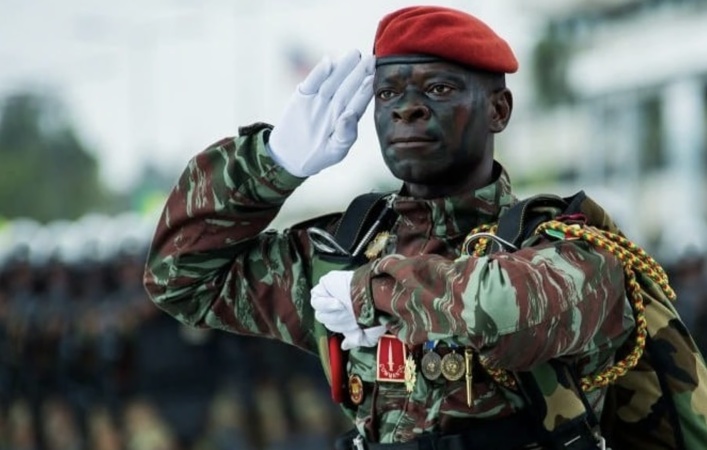
Pascal Tigri tried to overthrow the Beninese government in a failed coup
By ABDULRAZAQ MAGAJI
On Sunday, December 7, 2025, Beninoise nationals woke up to the sound of martial music. Soldiers, led by one Pascal Tigri, a lieutenant-colonel, announced they had dissolved the government, removed Patrice Talon from office, and abolished all state institutions.
This dramatic turn of events didn't happen in a vacuum. Across West Africa, military takeovers have surged in recent years, and the main reason, often cited is the steady, or perceived breakdown, of civilian governance: corruption, weakened institutions, contested elections, concentration of power, and public disillusionment. In many of these countries, the military’s intervention is, at least, partly justified by popular frustration with civilian governments.
The unfolding crisis in Benin thus deserves not only to be seen as a dramatic destabilizing event, but as something that makes military rule a “necessary” alternative. After decades of colonial rule and political upheaval, Benin had become a shining example of democratic transition in West Africa. Especially since the early 1990s, when Mathieu Kerekou was forced to step aside, its relative stability stood out. But the veneer of stability masked much deeper and festering problems.
As recently as last month, the legislature in Benin Republic extended the presidential term from five to seven years, even though the two-term limit was preserved. Critics saw it as an attempt to entrench power. In the run-up to the now-jeopardized general election next 2026, the ruling party’s candidate was widely expected to win, while opposition contenders were rejected on technical grounds, stirring accusations that democratic processes had been jettisoned.
As in other countries hit by coups, many citizens in West Africa no longer hold a sign of hope. Many no longer trust that democratic governance brings real improvement, considering the widespread corruption, banditry, economic stagnation, inequality, and institutional failure. Rather sadly, it is precisely this vacuum of legitimacy that opens the door for military actors. In milieu where formal institutions are deliberately weakened and perceived as rigged, self-serving, or incapable, the faction with rifles and a “save-the-nation” has the tendency to attract support.
Another troubling pattern, documented by analysts in recent years, is the role of politicians, business elites, bureaucrats in facilitating or even instigating coups. In fact, a recent research shows that in roughly 80% of successful coups worldwide since 1950, there was some form of civilian complicity, whether through providing resources, political backing, or moral legitimacy to the coup plotters. In the case of Benin, the authorities arrested a former minister and a well-connected businessman last year for allegedly plotting a coup, a clear indication that discontent over civilian misrule had already permeated elite circles.
To that extent, the military takeover in Benin Republic might not only reflect soldiers’ ambitions but also a breakdown of trust between the political class and the governed.
To a large extent, the military takeover in Benin Republic did not occur in isolation. Over the past five years, several countries in West and Central Africa have experienced coups or coup attempts. Observers increasingly see a regional pattern, among them, weakening democratic institutions, repeated electoral disputes, economic hardship, insecurity, corruption, which contribute to public disillusionment. In all cases, the military often presents itself, and is often received by the populace, as a corrective force, with the promise to reset the system, purge corruption, restore security and rework constitutional order.
Consciously or unconsciously, Benin’s return to military rule may be part of a broader continental rollback of democratic gains driven by the erosion of competence and legitimacy in civilian governments, and the growing belief that the military may, once more, deliver what democracy failed to: stability, order, and direction.
The unfolding developments in Benin have implications more far-reaching than its borders. Economic and regional stability is at risk because Benin plays a key role in subregional trade and transit. The military takeover could disrupt commerce with neighbours, scare off investors, and undermine regional economic integration.
The takeover also represents another blow to democratic momentum. For decades, the country was held up as a "successful" democratic story in the West African subregion. Its collapse may encourage copycat moves elsewhere. What is more, the military takeover in Benin Republic has the potential of eroding trust in institutions. If the public comes to expect that only force, not ballots, not courts, and not elections, can bring change, the underlying social contract between citizens and their governments stands jeopardised.
It is as tempting as it is wrong to look at the Benin coup as another aberration where a group of young army officers seize political power. A deeper and more troubling truth emerges when one asks why such a takeover appears acceptable to part of the population, or to influential members of society. The root of the problem is not just weak leadership or electoral irregularities. It is the erosion, over the decades, of credibility, accountability, and justice in governance. It is the perception that elections no longer matter; that institutions have been deliberately weakened and hollowed out; that elite capture and corruption are the norms; and that ordinary citizens lack any real avenue to influence their governance or choose their representatives. Tragically, when that happens, the temptation to look toward someone in military fatigues becomes understandable.
The coup in Benin Republic should serve as a sharp warning that, if democratic governance in Africa is to survive, reforms must go beyond periodic elections. There is need to strengthen institutions such as parliaments, courts, electoral commissions, anti-corruption bodies and make them genuinely independent and credible. There is also the need to enforce accountability by holding political elites to account, as well as ensuring transparency in governance and public finances where citizens can see tangible results. Equally important is the need to renew the social contract between citizens and governments through involving citizens meaningfully in governance.
The latest coup is a loud alarm bell. But, as has been reviewed above, the real sickness, chiefly the slow death of accountable, responsive, and legitimate civilian governance, predates the coup. When elected governments fail to deliver justice, fairness, growth, or dignity to their people, they lose their right to be called democratic. When politicians who publicly proclaim faith in democracy decide to turn to clandestine plots, vote-rigging, term-extensions, or hijacking the electoral and judicial processes, they erode the moral authority of democratic rule.
West Africa, and indeed Africa, can avoid slipping further into a cycle of military coups and counter-coups. To do this, the region must confront, not just the military interlopers, but the deeper rot inside its civilian leadership. That will mean a frontal attack on corruption, rebuilding institutions, restoring trust and seeing democracy, not merely as elections and power grabs.
•Magaji <magaji778@gmail.com > writes from Abuja.