Updating your news feed...
NEWS EXPRESS is Nigeria’s leading online newspaper. Published by Africa’s international award-winning journalist, Mr. Isaac Umunna, NEWS EXPRESS is Nigeria’s first truly professional online daily newspaper. It is published from Lagos, Nigeria’s economic and media hub, and has a provision for occasional special print editions. Thanks to our vast network of sources and dedicated team of professional journalists and contributors spread across Nigeria and overseas, NEWS EXPRESS has become synonymous with newsbreaks and exclusive stories from around the world.





Loading banners
Loading banners...

The delay in the presentation of the 2026 budget is making it difficult for businesses to plan for the new year, stakeholders and experts have said.
They said many businesses rely on the annual budget to make projections, hence the delay in its presentation is hurting them.
This is coming just as President Bola Ahmed Tinubu requested the Senate’s approval of the 2026–2028 Medium Term Expenditure Framework (MTEF) and Fiscal Strategy Paper (FSP), projecting that the federal government will generate N34.33 trillion in revenue in 2026.
Business owners and stakeholders who spoke with Daily Trust faulted the current budgetary system of the federal government, urging the president to return Nigeria to the January-to-December budget cycle.
Speaking with Daily Trust, the immediate past Chairman of the National Association of Small and Medium Enterprises (NASME) in Lagos State, Professor Adebayo Adams, stated that the delay in the presentation of the budget and the “haphazard” implementation of previous budgets is not good for the economy.
He stated that the current situation could be worsened by the fact that 2026 would be a year of intense political activities.
“The economy is going to face a lot of challenges,” he said, adding, “If the economy is not really robust in 2025, that means small businesses are going to suffer In 2026, especially in terms of inflation.
“By now we ought to know the budget parameters. How much are they going to generate and so on. If we don’t have all this as of now and the National Assembly has not received the budget, it means that the economy would suffer.
“A lot of uncertainty is being recorded and there is going to be a lot of fear in the mind of the investors. Those are the things that we need to work on and to let the government know that they are not really up to date in their responsibility in terms of giving the masses the privilege to have the information needed to make the economy to run smoothly.
“So this haphazard system or fire-brigade approach is not done anywhere in the world. No progressive economy can achieve good results without proper implementation processes.
“Our process and way of managing the economy is very faulty. The fundamental of economics is for you to know ahead and that is the essence of budget. You need to forecast and if it is not presented you won’t know what you are going to do,” he said.
Adebayo lamented that a few days to 2026, there is uncertainty over what would be the state of the economy, especially with the new tax laws that would be in place.
“I can assure you that electioneering would take over the entire 2026 and governance would suffer while everybody would be struggling for power. The way the economy is being run and the method we are using, we are just rigmaroling in the same cycle, we are not really doing well. The government needs to do what is necessary in terms of following due process and do the needful, rather than putting everybody in limbo.”
Another business leader, who spoke with our correspondent on the condition of anonymity, stated that many businesses, especially small ones anchor their annual planning on the budget.
“The Nigerian economy is still largely dependent on annual budget and the fact that we don’t have the budget presented is a major issue for many businesses. Though, the budget is a projection, it is the premise upon which many businesses also plan.
“I, for instance, given the kind of businesses we do, we have to look at some of the projects in the budget and then position ourselves for the opportunities in it.
“I want to plead with the government that this kind of budgetary system is not sustainable. It is not good for the economy because small businesses would suffer,” he said.
An economic analyst, Samuel Caulcrick, in a chat with our correspondent, however, expressed optimism that with the new tax laws, government’s revenue would increase to be able to achieve more in terms of budget implementation.
Caulcrick stated, “The budget is just a proposal based on what your income would be. But with the new tax reform, they would have more money to implement the budget.
“We have run this economy based on budget and everybody is waiting for budget because they believe it is only government’s business that would give them money.
“But this will change with the new tax law as the government will borrow less while the private sector will have access to more credit. The greatest thing the government has done is that tax reform and I believe it would open up opportunities for the private sector.”
Tinubu asks Senate to approve 2026–2028 MTEF, targets N34trn revenue
President Bola Ahmed Tinubu yesterday requested the Senate’s approval of the 2026–2028 Medium Term Expenditure Framework (MTEF) and Fiscal Strategy Paper (FSP), projecting that the federal government will generate N34.33 trillion in revenue in 2026.
The MTEF outlines the government’s revenue projections, expenditure plans, and fiscal targets, and according to the Fiscal Responsibility Act of 2007, the MTEF must be prepared by the executive, presented to the National Assembly for approval at least four months before the fiscal year begins, and must be approved before the annual budget can be presented.
Part 11 of the FRA says: “The Federal Government after consultation with the states shall – a. Not later than six months from the commencement of this Act, cause to be prepared and laid before the National Assembly, for their consideration a Medium-Term Expenditure Framework for the next three financial years; and b. Thereafter, not later than four months before commencement of the next financial year, cause to be prepared a medium – term expenditure Framework for the next three financial years.
“The framework so laid shall be considered for approval with such modifications, if any, as the National Assembly finds appropriate by a resolution of each House of the National Assembly.”
However, the MTEF is coming less than three weeks to the end of 2025 as Nigerians await the presentation of the 2026 budget.
The president’s request was conveyed in a letter read during Thursday’s plenary by Deputy Senate President Barau Jibrin, who presided over the session.
Although the president’s letter did not contain all accompanying details, it confirmed that the Federal Executive Council (FEC) had approved the fiscal framework on 3rd December, adopting a N34.33 trillion revenue projection for 2026.
The document also proposes an oil benchmark price of $64 per barrel, an exchange rate of N1,512 to the dollar, and a daily oil production estimate of 2.6 million barrels per day, with a more conservative 1.8 million barrels per day to be used for budgeting purposes.
In his letter, President Tinubu urged lawmakers to consider and approve the document in accordance with constitutional provisions.
“It is with pleasure that I forward the 2026–2028 Medium Term Expenditure Framework and Fiscal Strategy Paper for the kind consideration and approval of the Distinguished Senate.
“The 2026–2028 MTEF and FSP was approved during the Federal Executive Council meeting of December 3rd, 2025. As the 2026 budget of the Federal Government will be prepared based on the parameters and fiscal assumptions of the approved 2026–2028 MTEF and FSP, I seek the cooperation of the National Assembly for expeditious legislative action on the submission,” Tinubu’s letter reads in part.
After reading of the letter, Senator Barau Jibrin referred the request to the Senate Committee on Finance for further legislative action.
State of 2025 budget
The federal government had earlier urged all Ministries, Departments and Agencies to roll over 70 per cent of their 2025 capital budget to 2026. A circular signed by the Minister of Economic Planning and Budget, Sen. Abubakar Atiku Bagudu, said all the rollover and uploads must be in line with the immediate needs of the country as well as government’s development priorities that aligns with the policy direction of the new administration.
“This hinges on National Security, the Economy, Education, Health, Agriculture, Infrastructure, Power & Energy as well as social safety nets, women & youth empowerment.”
The circular added that the MDAs are also required to not exceed their 2025 overhead ceilings (Executive Proposal) for the purpose of preparing their 2026 Overhead budget submissions.
“While we note the impact of inflation on overhead costs, we are, however, constrained by revenue challenges in providing significantly more for overheads. We will, however, sustain the effort to achieve full release of the overhead budget.
“For the Sectoral Capital budget ceilings for 2026, and as stated in section 1.4, the federal government has established a framework for the 2026 Capital Budget, setting MDAs’ budget ceilings at 70% of their 2025 project allocations.
“This approach is based on the commitment to release 30% of the 2025 Capital Budget within the current fiscal year, with the remaining 70% balance being directly retained as the foundation for the 2026 budget rather than undergoing a traditional roll-over process.”
Daily Trust reports that there has been no record of capital allocation released to MDAs for the 2025 budget. There are fears that by the time the 2026 budget is presented, there would be four budgets in operation.
Speaking on the issue, an economic expert with the University of Ilọrin, Prof Gbolahan Bello, warned that Nigeria’s recurring problem with public finance is not limited to late passage of the national budget, but the failure to release funds on time, resulting in low implementation and weak outcomes across key sectors.
The expert said several ministries and agencies routinely receive less than half of their approved allocations, a situation that delays project execution and weakens economic performance.
He noted that implementation for many sectors begins halfway into the year, leading to persistent underperformance that affects investors, producers and service providers who rely on predictable government’s spending to plan their operations.
According to him, “The issue is not only when the budget is passed, the real problem is the execution. Even when funds are appropriated, releases often do not match what is approved. Many sectors end up receiving below fifty percent of their allocation. When execution starts late, performance will naturally be weak.”
He explained that Nigeria’s fiscal environment lacks clarity and stability, making it difficult to pinpoint a single cause for the delayed releases, but stressed that “the system is not working in a straight and predictable manner.”
The expert said the economy still lacks the level of certainty required for long term decisions, adding that the rise in revenue has not translated to relief for citizens or businesses. He noted that economic pressures continue to erode the potential gains from subsidy savings and improved export receipts.
“From an economic standpoint, the budget is a financial statement. Investors already have their plans. What they need are the figures to assign values. Revenue may be rising, but the common man is not feeling it. Until we see the full details of capital and recurrent spending, everyone is planning in the dark,” he said.
On the recently approved Medium Term Expenditure Framework by the Federal Executive Council, he explained that the three year fiscal plan provides guidance on revenue assumptions, expenditure limits and borrowing ahead of the detailed budget.
He noted that the borrowing requests submitted by the president for the 2026 cycle are tied to the parameters set in the framework, which is designed to stabilise the fiscal planning process.
The expert, however, added that despite the public claims on subsidy removal, several indirect subsidies are still being absorbed within the system, complicating the government’s fiscal outlook.
“These subsidies still exist in different forms. They make the budget less straightforward in economic terms,” he said.
He maintained that until the budget is backed by disciplined releases and timely execution, Nigeria will continue to record low performance regardless of when the document is passed. (Daily Trust)
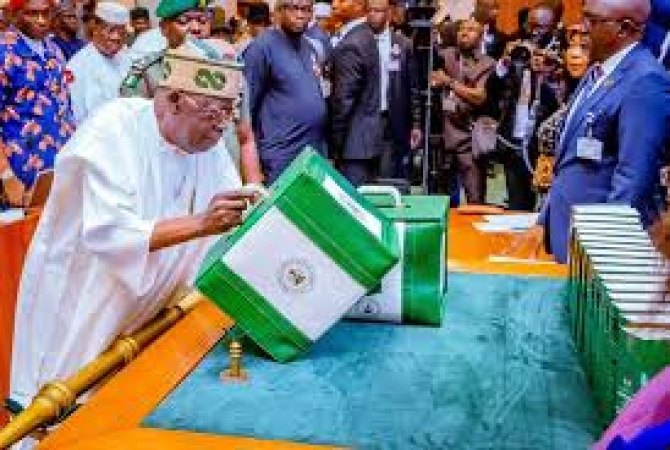
•President Bola Ahmed Tinubu presenting a budget of N27.5 trillion for the 2024 fiscal year to the joint session of the National Assembly last year